
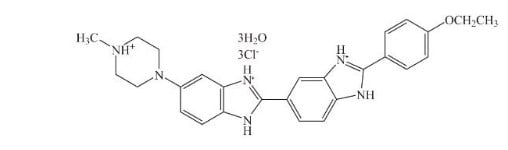
 Structure
(Fig. Hoechst 33342 structure formula)
Structure
(Fig. Hoechst 33342 structure formula)
Hoechst 33342 Staining Reagent
Hoechst 33342
Synonyms
Hoechst 33342; N/A; BMD00062; Hoechst 33342 staining reagent
Concentration
Recommended Working Concentrations: 0.5 - 10 ug/mL (varies by lot)
Excitation/Emission wavelengths
Ex/Em=350/461 nm (unbound DNA), Ex/Em=346/460 nm (bound DNA)
Tag
Hoechst 33342
Molecular Formula
C27H28N6O3HCl3H2O
Solubility
Soluble in water
Assay Procedure
1. Preparation of Hoechst 33342 staining solution
(1) Add 1 mL of deionized water to the EP tube to prepare a 10 mg/mL Hoechst 33342 storage solution.
(2) Hoechst 33342 storage solution was diluted with PBS at a ratio of 1:2,000 to Hoechst 33342 working solution at a final concentration of 5 ug/mL.
2. Staining
(1) For fixed cells or tissues
a. For cell or tissue samples, after fixation, the fixative was removed by appropriate washing. If immunofluorescence staining was to be performed, Hoechst 33342 staining was performed after the completion of staining.
b. For adherent cells or tissue sections, a small amount of Hoechst 33342 staining solution was added to cover the sample. For suspended cells, at least three times the volume of the sample to be stained was added and mixed.
c. Remove Hoechst 33342 staining solution, wash the cells with TBST, PBS or normal saline for 2-3 times, 3-5 min each time.
Note: Washing is optional but not required, dyeing will not be affected after washing.
d. Observe directly under fluorescence microscope or observe under fluorescence microscope after mounting. When apoptosis occurs, the nuclei of apoptotic cells are dense and densely stained, or fragmented and densely stained.
(2) For living cells or tissues
a. Appropriate amount of Hoechst 33342 staining solution was added to cover the sample. Generally, 1 mL was added to 6-well plate per well, 100 uL to 96-well plate per well.
b. Incubate at room temperature 10-30 min, protected from light.
c. Remove Hoechst 33342 staining solution, wash the cells with PBS for 2-3 times, then add 50 uL PBS to cover the cells.
Observe directly under fluorescence microscope
Note: Washing is optional but not required, dyeing will not be affected after washing.
(1) Add 1 mL of deionized water to the EP tube to prepare a 10 mg/mL Hoechst 33342 storage solution.
(2) Hoechst 33342 storage solution was diluted with PBS at a ratio of 1:2,000 to Hoechst 33342 working solution at a final concentration of 5 ug/mL.
2. Staining
(1) For fixed cells or tissues
a. For cell or tissue samples, after fixation, the fixative was removed by appropriate washing. If immunofluorescence staining was to be performed, Hoechst 33342 staining was performed after the completion of staining.
b. For adherent cells or tissue sections, a small amount of Hoechst 33342 staining solution was added to cover the sample. For suspended cells, at least three times the volume of the sample to be stained was added and mixed.
c. Remove Hoechst 33342 staining solution, wash the cells with TBST, PBS or normal saline for 2-3 times, 3-5 min each time.
Note: Washing is optional but not required, dyeing will not be affected after washing.
d. Observe directly under fluorescence microscope or observe under fluorescence microscope after mounting. When apoptosis occurs, the nuclei of apoptotic cells are dense and densely stained, or fragmented and densely stained.
(2) For living cells or tissues
a. Appropriate amount of Hoechst 33342 staining solution was added to cover the sample. Generally, 1 mL was added to 6-well plate per well, 100 uL to 96-well plate per well.
b. Incubate at room temperature 10-30 min, protected from light.
c. Remove Hoechst 33342 staining solution, wash the cells with PBS for 2-3 times, then add 50 uL PBS to cover the cells.
Observe directly under fluorescence microscope
Note: Washing is optional but not required, dyeing will not be affected after washing.
Precautions
1. Please immediately centrifugal the product to the bottom of the tube before use, and then conduct the subsequent
experiments.
2. Hoechst dye is commonly used to stain mammalian cells, but it can also be used to stain dead and living bacteria. For the staining of dead and living bacteria, it is recommended to dissolve the solution in PBS or 150 mM NaCl with the final concentration of 12-15 ug/mL for 30 min at room temperature. The staining of yeast is weak. Usually the staining of dead cells is brighter than that of living cells.
3. The Hoechst 33342 dye has a solubility of 10 mg/mL when dissolved in water. The recommended working concentration of Hoechst 33342 for nuclear staining is 0.5-10 ug/mL. The dyeing solution concentration and dyeing time can be explored according to the actual dyeing situation
4. Fluorescent dyes all have quenching problems, please try to avoid light to slow down the quenching.
2. Hoechst dye is commonly used to stain mammalian cells, but it can also be used to stain dead and living bacteria. For the staining of dead and living bacteria, it is recommended to dissolve the solution in PBS or 150 mM NaCl with the final concentration of 12-15 ug/mL for 30 min at room temperature. The staining of yeast is weak. Usually the staining of dead cells is brighter than that of living cells.
3. The Hoechst 33342 dye has a solubility of 10 mg/mL when dissolved in water. The recommended working concentration of Hoechst 33342 for nuclear staining is 0.5-10 ug/mL. The dyeing solution concentration and dyeing time can be explored according to the actual dyeing situation
4. Fluorescent dyes all have quenching problems, please try to avoid light to slow down the quenching.
Preparation and Storage
Store at -20 degree C and protect from light.
Structure
(Fig. Hoechst 33342 structure formula)
Structure
(Fig. Hoechst 33342 structure formula)
Related Product Information for Hoechst 33342 staining reagent
Hoechst 33342, also known as bis Benzimide H 33342 or HOE 33342, DAPI has the molecular formula C27H28N6O-3HCl-3H2O, molecular weight 616.0 and CAS number 881691-13-0, is a non-embedded bright blue fluorescent dye. Dyes have weak fluorescence in solution, but they become bright after binding to DNA in the groove of DNA poly AT sequence enriched region in living cells, so such dyes are also called DNA probes. Due to the low background staining cells do not need washing and the staining is very stable, non-toxic to living cells, and the fluorescence can last for several days or longer after combining with DNA staining. Hoechst33342 has lower solubility in water than Hoechst 33258, but both dyes have high cell membrane permeability and are widely used for apoptosis detection. After staining, fluorescence microscopy or flow cytometry can be used for detection. In the case of adherent cells (96-well plates), 100 uL of the staining solution was used in each well, and the concentration of the staining solution was calculated as 5 ug/mL. 10 mg of the staining solution could be used in 20,000 wells.
Product Categories/Family for Hoechst 33342 staining reagent
Customer Reviews
Loading reviews...
Share Your Experience
Similar Products
Product Notes
The Hoechst 33342 (Catalog #AAA332503) is a Staining Reagent and is intended for research purposes only. The product is available for immediate purchase. It is sometimes possible for the material contained within the vial of "Hoechst 33342, Staining Reagent" to become dispersed throughout the inside of the vial, particularly around the seal of said vial, during shipment and storage. We always suggest centrifuging these vials to consolidate all of the liquid away from the lid and to the bottom of the vial prior to opening. Please be advised that certain products may require dry ice for shipping and that, if this is the case, an additional dry ice fee may also be required.Precautions
All products in the AAA Biotech catalog are strictly for research-use only, and are absolutely not suitable for use in any sort of medical, therapeutic, prophylactic, in-vivo, or diagnostic capacity. By purchasing a product from AAA Biotech, you are explicitly certifying that said products will be properly tested and used in line with industry standard. AAA Biotech and its authorized distribution partners reserve the right to refuse to fulfill any order if we have any indication that a purchaser may be intending to use a product outside of our accepted criteria.Disclaimer
Though we do strive to guarantee the information represented in this datasheet, AAA Biotech cannot be held responsible for any oversights or imprecisions. AAA Biotech reserves the right to adjust any aspect of this datasheet at any time and without notice. It is the responsibility of the customer to inform AAA Biotech of any product performance issues observed or experienced within 30 days of receipt of said product. To see additional details on this or any of our other policies, please see our Terms & Conditions page.Item has been added to Shopping Cart
If you are ready to order, navigate to Shopping Cart and get ready to checkout.