
 Application Data
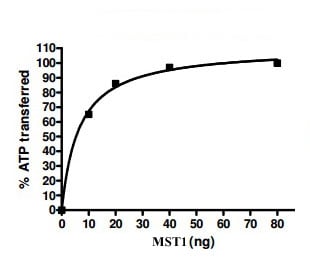
(MST1 activity assay. Recombinant MST1 activity measured using a fluorescent kinase assay.)
Application Data
(MST1 activity assay. Recombinant MST1 activity measured using a fluorescent kinase assay.)
MST1 recombinant protein
Recombinant MST1 protein
Gene Names
STK4; KRS2; MST1; YSK3; DKFZp686A2068
Synonyms
MST1; N/A; Recombinant MST1 protein; Mammalian STE20-Like Protein Kinase 1; STK4; KRS2; YSK3; TIIAC; MST1 recombinant protein
Host
Baculovirus
Form/Format
10ug recombinant Mst1 expressed in Sf9 cells and supplied in a buffer of 45mM Tris-HCl, pH8.0, 124mM NaCl, 2.4mM KCl, 3mM DTT, 18mM glutathione, and 10% glycerol.
Protein Species
Human
Tag
GST-Tag
Protein Details
Amino acids 2-488 of MST1 (accession number NP_006273.1) were expressed with an N-terminal GST-Tag, (82kDa) in Sf9 cells using a baculovirus expression system.
Notes
Recombinant MST1 is suitable for use in kinase assays. A good starting point is 5 to 25ng of enzyme per assay.
Dry Ice Note
The product may be shipped with dry ice, and an additional fee may be added to your shipping cost.
Preparation and Storage
Recombinant proteins in solution are temperature sensitive and must be stored at -80 degree C to prevent degradation. Avoid repeated freeze/thaw cycles and keep on ice when not in storage.
Shipping Temp: Dry Ice
Shipping Temp: Dry Ice
Application Data
(MST1 activity assay. Recombinant MST1 activity measured using a fluorescent kinase assay.)
Application Data
(MST1 activity assay. Recombinant MST1 activity measured using a fluorescent kinase assay.)
SDS-PAGE
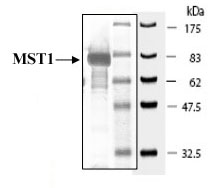
(MST1 protein gel. MST1 (6 ?g) run on an SDS-PAGE gel and stained with Coomassie blue.)
SDS-PAGE
(MST1 protein gel. MST1 (6 ?g) run on an SDS-PAGE gel and stained with Coomassie blue.)
Related Product Information for MST1 recombinant protein
Short Description: MST1 (Mammalian STE20-like protein kinase 1, STK4, KRS2) is a kinase that phosphorylates histone H2B at serine 14 during apoptosis and in response to double-strand DNA breakage. Amino acids 2-488 of MST1 (accession number NP_006273.1) were expressed with an N-terminal GST-Tag, (MW = 82 kDa) in Sf9 cells using a baculovirus expression system. Recombinant MST1 protein can be used in kinase assays.
Background: MST1 (Mammalian STE20-Like Protein Kinase 1) is a stress-activated, pro-apoptotic kinase which, following caspase-cleavage, enters the nucleus and induces chromatin condensation followed by internucleosomal DNA fragmentation. Key component of the Hippo signaling pathway which plays a pivotal role in organ size control and tumor suppression by restricting proliferation and promoting apoptosis. The core of this pathway is composed of a kinase cascade wherein STK3/MST2 and STK4/MST1, in complex with its regulatory protein SAV1, phosphorylates and activates LATS1/2 in complex with its regulatory protein MOB1, which in turn phosphorylates and inactivates YAP1 oncoprotein and WWTR1/TAZ. Phosphorylation of YAP1 by LATS2 inhibits its translocation into the nucleus to regulate cellular genes important for cell proliferation, cell death, and cell migration. STK3/MST2 and STK4/MST1 are required to repress proliferation of mature hepatocytes, to prevent activation of facultative adult liver stem cells (oval cells), and to inhibit tumor formation (By similarity). Phosphorylates Ser-14 of histone H2B (H2BS14ph) during apoptosis. Phosphorylates FOXO3 upon oxidative stress, which results in its nuclear translocation and cell death initiation. Phosphorylates MOBKL1A, MOBKL1B and RASSF2. Phosphorylates TNNI3 (cardiac Tn-I) and alters its binding affinity to TNNC1 (cardiac Tn-C) and TNNT2 (cardiac Tn-T). Phosphorylates FOXO1 on Ser-212 and regulates its activation and stimulates transcription of PMAIP1 in a FOXO1-dependent manner. Phosphorylates SIRT1 and inhibits SIRT1-mediated p53/TP53 deacetylation, thereby promoting p53/TP53 dependent transcription and apoptosis upon DNA damage. Acts as an inhibitor of PKB/AKT1. Phosphorylates AR on Ser-650 and suppresses its activity by intersecting with PKB/AKT1 signaling and antagonizing formation of AR-chromatin complexes.
Background: MST1 (Mammalian STE20-Like Protein Kinase 1) is a stress-activated, pro-apoptotic kinase which, following caspase-cleavage, enters the nucleus and induces chromatin condensation followed by internucleosomal DNA fragmentation. Key component of the Hippo signaling pathway which plays a pivotal role in organ size control and tumor suppression by restricting proliferation and promoting apoptosis. The core of this pathway is composed of a kinase cascade wherein STK3/MST2 and STK4/MST1, in complex with its regulatory protein SAV1, phosphorylates and activates LATS1/2 in complex with its regulatory protein MOB1, which in turn phosphorylates and inactivates YAP1 oncoprotein and WWTR1/TAZ. Phosphorylation of YAP1 by LATS2 inhibits its translocation into the nucleus to regulate cellular genes important for cell proliferation, cell death, and cell migration. STK3/MST2 and STK4/MST1 are required to repress proliferation of mature hepatocytes, to prevent activation of facultative adult liver stem cells (oval cells), and to inhibit tumor formation (By similarity). Phosphorylates Ser-14 of histone H2B (H2BS14ph) during apoptosis. Phosphorylates FOXO3 upon oxidative stress, which results in its nuclear translocation and cell death initiation. Phosphorylates MOBKL1A, MOBKL1B and RASSF2. Phosphorylates TNNI3 (cardiac Tn-I) and alters its binding affinity to TNNC1 (cardiac Tn-C) and TNNT2 (cardiac Tn-T). Phosphorylates FOXO1 on Ser-212 and regulates its activation and stimulates transcription of PMAIP1 in a FOXO1-dependent manner. Phosphorylates SIRT1 and inhibits SIRT1-mediated p53/TP53 deacetylation, thereby promoting p53/TP53 dependent transcription and apoptosis upon DNA damage. Acts as an inhibitor of PKB/AKT1. Phosphorylates AR on Ser-650 and suppresses its activity by intersecting with PKB/AKT1 signaling and antagonizing formation of AR-chromatin complexes.
Product Categories/Family for MST1 recombinant protein
NCBI and Uniprot Product Information
NCBI GI #
NCBI GeneID
NCBI Accession #
NCBI GenBank Nucleotide #
UniProt Accession #
Molecular Weight
55,630 Da
NCBI Official Full Name
serine/threonine-protein kinase 4
NCBI Official Synonym Full Names
serine/threonine kinase 4
NCBI Official Symbol
STK4
NCBI Official Synonym Symbols
KRS2; MST1; YSK3; DKFZp686A2068
NCBI Protein Information
serine/threonine-protein kinase 4; MST-1; OTTHUMP00000043418; OTTHUMP00000063226; STE20-like kinase MST1; mammalian sterile 20-like 1; kinase responsive to stress 2; mammalian STE20-like protein kinase 1; serine/threonine-protein kinase Krs-2; dJ211D12.2
UniProt Protein Name
Serine/threonine-protein kinase 4
UniProt Gene Name
STK4
UniProt Synonym Gene Names
KRS2; MST1; MST-1; MST1/N; MST1/C
Customer Reviews
Loading reviews...
Share Your Experience
Similar Products


Product Notes
The MST1 stk4 (Catalog #AAA59637) is a Recombinant Protein produced from Baculovirus and is intended for research purposes only. The product is available for immediate purchase. It is sometimes possible for the material contained within the vial of "MST1, Recombinant Protein" to become dispersed throughout the inside of the vial, particularly around the seal of said vial, during shipment and storage. We always suggest centrifuging these vials to consolidate all of the liquid away from the lid and to the bottom of the vial prior to opening. Please be advised that certain products may require dry ice for shipping and that, if this is the case, an additional dry ice fee may also be required.Precautions
All products in the AAA Biotech catalog are strictly for research-use only, and are absolutely not suitable for use in any sort of medical, therapeutic, prophylactic, in-vivo, or diagnostic capacity. By purchasing a product from AAA Biotech, you are explicitly certifying that said products will be properly tested and used in line with industry standard. AAA Biotech and its authorized distribution partners reserve the right to refuse to fulfill any order if we have any indication that a purchaser may be intending to use a product outside of our accepted criteria.Disclaimer
Though we do strive to guarantee the information represented in this datasheet, AAA Biotech cannot be held responsible for any oversights or imprecisions. AAA Biotech reserves the right to adjust any aspect of this datasheet at any time and without notice. It is the responsibility of the customer to inform AAA Biotech of any product performance issues observed or experienced within 30 days of receipt of said product. To see additional details on this or any of our other policies, please see our Terms & Conditions page.Item has been added to Shopping Cart
If you are ready to order, navigate to Shopping Cart and get ready to checkout.