
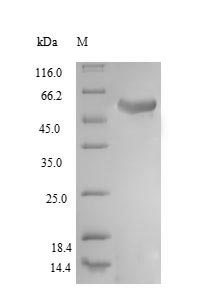
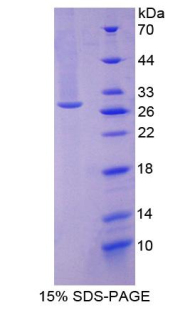
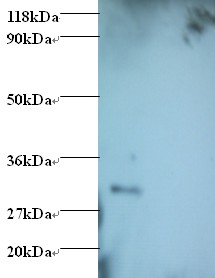
 SDS-PAGE
Ubiquitin carboxyl-terminal hydrolase 14 Recombinant Protein | USP14 recombinant protein
Recombinant Human Ubiquitin carboxyl-terminal hydrolase 14
Gene Names
USP14; TGT
Purity
Greater or equal to 85% purity as determined by SDS-PAGE.
Synonyms
Ubiquitin carboxyl-terminal hydrolase 14; N/A; Recombinant Human Ubiquitin carboxyl-terminal hydrolase 14; Deubiquitinating enzyme 14; Ubiquitin thioesterase 14; Ubiquitin-specific-processing protease 14; USP14 recombinant protein
Host
E Coli or Yeast or Baculovirus or Mammalian Cell
Purity/Purification
Greater or equal to 85% purity as determined by SDS-PAGE.
Form/Format
Lyophilized or liquid (Format to be determined during the manufacturing process)
Sequence Positions
1-494aa; Full Length
Sequence
MPLYSVTVKW GKEKFEGVEL NTDEPPMVFK AQLFALTGVQ PARQKVMVKG GTLKDDDWGN IKIKNGMTLL MMGSADALPE EPSAKTVFVE DMTEEQLASA MELPCGLTNL GNTCYMNATV QCIRSVPELK DALKRYAGAL RASGEMASAQ YITAALRDLF DSMDKTSSSI PPIILLQFLH MAFPQFAEKG EQGQYLQQDA NECWIQMMRV LQQKLEAIED DSVKETDSSS ASAATPSKKK SLIDQFFGVE FETTMKCTES EEEEVTKGKE NQLQLSCFIN QEVKYLFTGL KLRLQEEITK QSPTLQRNAL YIKSSKISRL PAYLTIQMVR FFYKEKESVN AKVLKDVKFP LMLDMYELCT PELQEKMVSF RSKFKDLEDK KVNQQPNTSD KKSSPQKEVK YEPFSFADDI GSNNCGYYDL QAVLTHQGRS SSSGHYVSWV KRKQDEWIKF DDDKVSIVTP EDILRLSGGG DWHIAYVLLY GPRRVEIMEE ESEQ
Preparation and Storage
Store at -20 degree C, for extended storage, conserve at -20 degree C or -80 degree C.
SDS-PAGE
SDS-PAGE
Related Product Information for USP14 recombinant protein
Proteasome-associated deubiquitinase which releases ubiquitin from the proteasome targeted ubiquitinated proteins. Ensures the regeneration of ubiquitin at the proteasome. Is a reversibly associated subunit of the proteasome and a large fraction of proteasome-free protein exists within the cell. Required for the degradation of the chokine receptor CXCR4 which is critical for CXCL12-induced cell chemotaxis. Serves also as a physiological inhibitor of endoplasmic reticulum-associated degradation (ERAD) under the non-stressed condition by inhibiting the degradation of unfolded endoplasmic reticulum proteins via interaction with ERN1. Indispensable for synaptic development and function at neuromuscular junctions (NMJs).
Product Categories/Family for USP14 recombinant protein
References
tRNA-guanine transglycosylase cDNA from human placenta.Deshpande K.L., Katze J.R. Cloning of human full-length CDSs in BD Creator(TM) system donor vector.Kalnine N., Chen X., Rolfs A., Halleck A., Hines L., Eisenstein S., Koundinya M., Raphael J., Moreira D., Kelley T., LaBaer J., Lin Y., Phelan M., Farmer A.Complete sequencing and characterization of 21,243 full-length human cDNAs.Ota T., Suzuki Y., Nishikawa T., Otsuki T., Sugiyama T., Irie R., Wakamatsu A., Hayashi K., Sato H., Nagai K., Kimura K., Makita H., Sekine M., Obayashi M., Nishi T., Shibahara T., Tanaka T., Ishii S., Yamamoto J., Saito K., Kawai Y., Isono Y., Nakamura Y., Nagahari K., Murakami K., Yasuda T., Iwayanagi T., Wagatsuma M., Shiratori A., Sudo H., Hosoiri T., Kaku Y., Kodaira H., Kondo H., Sugawara M., Takahashi M., Kanda K., Yokoi T., Furuya T., Kikkawa E., Omura Y., Abe K., Kamihara K., Katsuta N., Sato K., Tanikawa M., Yamazaki M., Ninomiya K., Ishibashi T., Yamashita H., Murakawa K., Fujimori K., Tanai H., Kimata M., Watanabe M., Hiraoka S., Chiba Y., Ishida S., Ono Y., Takiguchi S., Watanabe S., Yosida M., Hotuta T., Kusano J., Kanehori K., Takahashi-Fujii A., Hara H., Tanase T.-O., Nomura Y., Togiya S., Komai F., Hara R., Takeuchi K., Arita M., Imose N., Musashino K., Yuuki H., Oshima A., Sasaki N., Aotsuka S., Yoshikawa Y., Matsunawa H., Ichihara T., Shiohata N., Sano S., Moriya S., Momiyama H., Satoh N., Takami S., Terashima Y., Suzuki O., Nakagawa S., Senoh A., Mizoguchi H., Goto Y., Shimizu F., Wakebe H., Hishigaki H., Watanabe T., Sugiyama A., Takemoto M., Kawakami B., Yamazaki M., Watanabe K., Kumagai A., Itakura S., Fukuzumi Y., Fujimori Y., Komiyama M., Tashiro H., Tanigami A., Fujiwara T., Ono T., Yamada K., Fujii Y., Ozaki K., Hirao M., Ohmori Y., Kawabata A., Hikiji T., Kobatake N., Inagaki H., Ikema Y., Okamoto S., Okitani R., Kawakami T., Noguchi S., Itoh T., Shigeta K., Senba T., Matsumura K., Nakajima Y., Mizuno T., Morinaga M., Sasaki M., Togashi T., Oyama M., Hata H., Watanabe M., Komatsu T., Mizushima-Sugano J., Satoh T., Shirai Y., Takahashi Y., Nakagawa K., Okumura K., Nagase T., Nomura N., Kikuchi H., Masuho Y., Yamashita R., Nakai K., Yada T., Nakamura Y., Ohara O., Isogai T., Sugano S.Nat. Genet. 36:40-45(2004) DNA sequence and analysis of human chromosome 18.Nusbaum C., Zody M.C., Borowsky M.L., Kamal M., Kodira C.D., Taylor T.D., Whittaker C.A., Chang J.L., Cuomo C.A., Dewar K., FitzGerald M.G., Yang X., Abouelleil A., Allen N.R., Anderson S., Bloom T., Bugalter B., Butler J., Cook A., DeCaprio D., Engels R., Garber M., Gnirke A., Hafez N., Hall J.L., Norman C.H., Itoh T., Jaffe D.B., Kuroki Y., Lehoczky J., Lui A., Macdonald P., Mauceli E., Mikkelsen T.S., Naylor J.W., Nicol R., Nguyen C., Noguchi H., O'Leary S.B., Piqani B., Smith C.L., Talamas J.A., Topham K., Totoki Y., Toyoda A., Wain H.M., Young S.K., Zeng Q., Zimmer A.R., Fujiyama A., Hattori M., Birren B.W., Sakaki Y., Lander E.S.Nature 437:551-555(2005) Heil O., Ebert L., Hennig S., Henze S., Radelof U., Schneider D., Korn B. Yeast two-hybrid screens imply involvement of Fanconi anemia proteins in transcription regulation, cell signaling, oxidative metabolism, and cellular transport.Reuter T.Y., Medhurst A.L., Waisfisz Q., Zhi Y., Herterich S., Hoehn H., Gross H.J., Joenje H., Hoatlin M.E., Mathew C.G., Huber P.A.Exp. Cell Res. 289:211-221(2003) Phosphorylation analysis of primary human T lymphocytes using sequential IMAC and titanium oxide enrichment.Carrascal M., Ovelleiro D., Casas V., Gay M., Abian J.J. Proteome Res. 7:5167-5176(2008) Relative structural and functional roles of multiple deubiquitylating proteins associated with mammalian 26S proteasome.Koulich E., Li X., De;Martino G.N.Mol. Biol. Cell 19:1072-1082(2008) A quantitative atlas of mitotic phosphorylation.Dephoure N., Zhou C., Villen J., Beausoleil S.A., Bakalarski C.E., Elledge S.J., Gygi S.P.Proc. Natl. Acad. Sci. U.S.A. 105:10762-10767(2008) USP14 inhibits ER-associated degradation via interaction with IRE1alpha.Nagai A., Kadowaki H., Maruyama T., Takeda K., Nishitoh H., Ichijo H.Biochem. Biophys. Res. Commun. 379:995-1000(2009) Deubiquitination of CXCR4 by USP14 is critical for both CXCL12-induced CXCR4 degradation and chemotaxis but not ERK activation.Mines M.A., Goodwin J.S., Limbird L.E., Cui F.F., Fan G.H.J. Biol. Chem. 284:5742-5752(2009) Quantitative phosphoproteomic analysis of T cell receptor signaling reveals system-wide modulation of protein-protein interactions.Mayya V., Lundgren D.H., Hwang S.-I., Rezaul K., Wu L., Eng J.K., Rodionov V., Han D.K.Sci. Signal. 2:RA46-RA46(2009) Lysine acetylation targets protein complexes and co-regulates major cellular functions.Choudhary C., Kumar C., Gnad F., Nielsen M.L., Rehman M., Walther T.C., Olsen J.V., Mann M.Science 325:834-840(2009) Quantitative phosphoproteomics reveals widespread full phosphorylation site occupancy during mitosis.Olsen J.V., Vermeulen M., Santamaria A., Kumar C., Miller M.L., Jensen L.J., Gnad F., Cox J., Jensen T.S., Nigg E.A., Brunak S., Mann M.Sci. Signal. 3:RA3-RA3(2010) Initial characterization of the human central proteome.Burkard T.R., Planyavsky M., Kaupe I., Breitwieser F.P., Buerckstuemmer T., Bennett K.L., Superti-Furga G., Colinge J.BMC Syst. Biol. 5:17-17(2011) System-wide temporal characterization of the proteome and phosphoproteome of human embryonic stem cell differentiation.Rigbolt K.T., Prokhorova T.A., Akimov V., Henningsen J., Johansen P.T., Kratchmarova I., Kassem M., Mann M., Olsen J.V., Blagoev B.Sci. Signal. 4:RS3-RS3(2011) An enzyme assisted RP-RPLC approach for in-depth analysis of human liver phosphoproteome.Bian Y., Song C., Cheng K., Dong M., Wang F., Huang J., Sun D., Wang L., Ye M., Zou H.J. Proteomics 96:253-262(2014) Structure and mechanisms of the proteasome-associated deubiquitinating enzyme USP14.Hu M., Li P., Song L., Jeffrey P.D., Chenova T.A., Wilkinson K.D., Cohen R.E., Shi Y.EMBO J. 24:3747-3756(2005)
NCBI and Uniprot Product Information
NCBI GI #
NCBI GeneID
NCBI Accession #
NCBI GenBank Nucleotide #
Molecular Weight
60.1 kDa
NCBI Official Full Name
ubiquitin carboxyl-terminal hydrolase 14 isoform b
NCBI Official Synonym Full Names
ubiquitin specific peptidase 14 (tRNA-guanine transglycosylase)
NCBI Official Symbol
USP14
NCBI Official Synonym Symbols
TGT
NCBI Protein Information
ubiquitin carboxyl-terminal hydrolase 14
UniProt Protein Name
Ubiquitin carboxyl-terminal hydrolase 14
UniProt Gene Name
USP14
UniProt Synonym Gene Names
TGT
UniProt Entry Name
UBP14_HUMAN
Customer Reviews
Loading reviews...
Share Your Experience
Similar Products


Product Notes
The USP14 usp14 (Catalog #AAA113525) is a Recombinant Protein produced from E Coli or Yeast or Baculovirus or Mammalian Cell and is intended for research purposes only. The product is available for immediate purchase. The immunogen sequence is 1-494aa; Full Length. The amino acid sequence is listed below: MPLYSVTVKW GKEKFEGVEL NTDEPPMVFK AQLFALTGVQ PARQKVMVKG GTLKDDDWGN IKIKNGMTLL MMGSADALPE EPSAKTVFVE DMTEEQLASA MELPCGLTNL GNTCYMNATV QCIRSVPELK DALKRYAGAL RASGEMASAQ YITAALRDLF DSMDKTSSSI PPIILLQFLH MAFPQFAEKG EQGQYLQQDA NECWIQMMRV LQQKLEAIED DSVKETDSSS ASAATPSKKK SLIDQFFGVE FETTMKCTES EEEEVTKGKE NQLQLSCFIN QEVKYLFTGL KLRLQEEITK QSPTLQRNAL YIKSSKISRL PAYLTIQMVR FFYKEKESVN AKVLKDVKFP LMLDMYELCT PELQEKMVSF RSKFKDLEDK KVNQQPNTSD KKSSPQKEVK YEPFSFADDI GSNNCGYYDL QAVLTHQGRS SSSGHYVSWV KRKQDEWIKF DDDKVSIVTP EDILRLSGGG DWHIAYVLLY GPRRVEIMEE ESEQ. It is sometimes possible for the material contained within the vial of "Ubiquitin carboxyl-terminal hydrolase 14, Recombinant Protein" to become dispersed throughout the inside of the vial, particularly around the seal of said vial, during shipment and storage. We always suggest centrifuging these vials to consolidate all of the liquid away from the lid and to the bottom of the vial prior to opening. Please be advised that certain products may require dry ice for shipping and that, if this is the case, an additional dry ice fee may also be required.Precautions
All products in the AAA Biotech catalog are strictly for research-use only, and are absolutely not suitable for use in any sort of medical, therapeutic, prophylactic, in-vivo, or diagnostic capacity. By purchasing a product from AAA Biotech, you are explicitly certifying that said products will be properly tested and used in line with industry standard. AAA Biotech and its authorized distribution partners reserve the right to refuse to fulfill any order if we have any indication that a purchaser may be intending to use a product outside of our accepted criteria.Disclaimer
Though we do strive to guarantee the information represented in this datasheet, AAA Biotech cannot be held responsible for any oversights or imprecisions. AAA Biotech reserves the right to adjust any aspect of this datasheet at any time and without notice. It is the responsibility of the customer to inform AAA Biotech of any product performance issues observed or experienced within 30 days of receipt of said product. To see additional details on this or any of our other policies, please see our Terms & Conditions page.Item has been added to Shopping Cart
If you are ready to order, navigate to Shopping Cart and get ready to checkout.