Chromatography: Principles, Techniques, and Applications in Life Science
 Cynthia
10 min read
Cynthia
10 min read
In this Article


All of the products listed in AAA Biotech’s catalog are strictly for research-use only (RUO).
5 Key Takeaways
- Chromatography separates mixtures by differential affinity between components and two phases: the mobile phase and the stationary phase.
- The mobile phase—solvent, buffer, or carrier gas—controls transport speed, elution strength, and separation resolution.
- Stationary phase chemistry determines the separation mode based on size, charge, hydrophobicity, or biospecific affinity.
- Affinity chromatography, Size Exclusion Chromatography (SEC), and Ion Exchange Chromatography (IEX) are the core techniques used in antibody and biologic workflows.
- HPLC provides high analytical precision, while GC is designed specifically for volatile small molecules.
Chromatography is the foundational separation technology behind every protein purification run, every antibody lot release, and every drug purity assay in modern biomedical research.
Understanding the basics of how it works, why phase interactions matter, which technique to reach for, and what it means for your downstream reagent quality is integral to the success of your experiments.
What Is Chromatography?
Chromatography is an analytical and preparative separation technique that resolves the components of a complex mixture by distributing them between two phases — a mobile phase that carries the sample, and a stationary phase through which it passes.
Each component in the mixture partitions between the two phases according to its distinct physical or chemical properties: polarity, molecular size, net charge, or biospecific affinity. Because components partition differently, they migrate at different velocities and emerge from the system at separate, characteristic times.
The term itself derives from the Greek chroma (color) and graphein (to write), tracing back to Mikhail Tsvet's early 1900s separation of plant pigments on chalk, which is a lineage that bears little resemblance to modern high-performance liquid systems, yet the underlying physics remain exactly the same.
Formally defined: chromatography is a separation technique in which a mixture dissolved in a mobile phase is separated into its components as it passes over or through a stationary phase, based on differential affinity between each component and the two phases.
Key Principle: Chromatography does not alter the chemical identity of the components being separated. It exploits existing physical and chemical differences and amplifies them into measurable, collectible fractions.
How Does Chromatography Work?
The mechanism of any chromatographic separation follows a reproducible sequence: a sample mixture is introduced into the system, a mobile phase transports it through the stationary phase, components interact with that phase at differing strengths, and the resulting differential migration produces spatially or temporally resolved peaks that can be detected and collected.
The practical variables — flow rate, buffer composition, temperature, loading volume, gradient slope — all influence how cleanly that separation occurs. Understanding the mechanism means understanding how each variable enters the equation, and where to intervene when resolution degrades.
The Two Phases of Chromatography Explained
- Phase 1: Mobile Phase
The liquid or gas carrier that flows continuously through the system, transporting the dissolved sample across or through the stationary medium. In HPLC, this is typically an aqueous-organic solvent system. In gas chromatography, it is an inert carrier gas such as helium or nitrogen. Buffer composition, pH, ionic strength, and gradient profile are all mobile-phase variables that the researcher controls.
- Phase 2: Stationary Phase
The solid or immobilized liquid medium through which the sample traverses. Its chemical character determines the mode of separation: a C18 reverse-phase sorbent exploits hydrophobicity, an ion-exchange resin exploits charge, a Protein A column exploits biospecific affinity, and a size-exclusion matrix exploits pore geometry. Stationary phase selection is the primary architectural decision in method development.
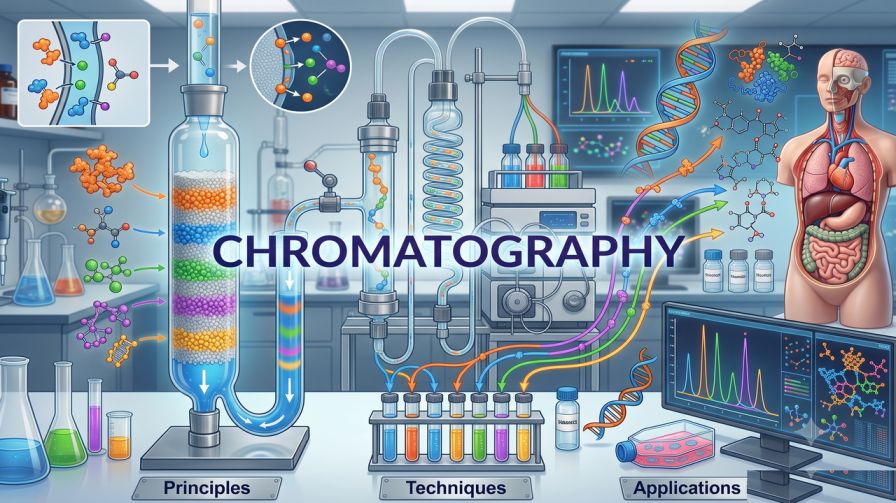
The following illustration shows the general principles of Chromatography:
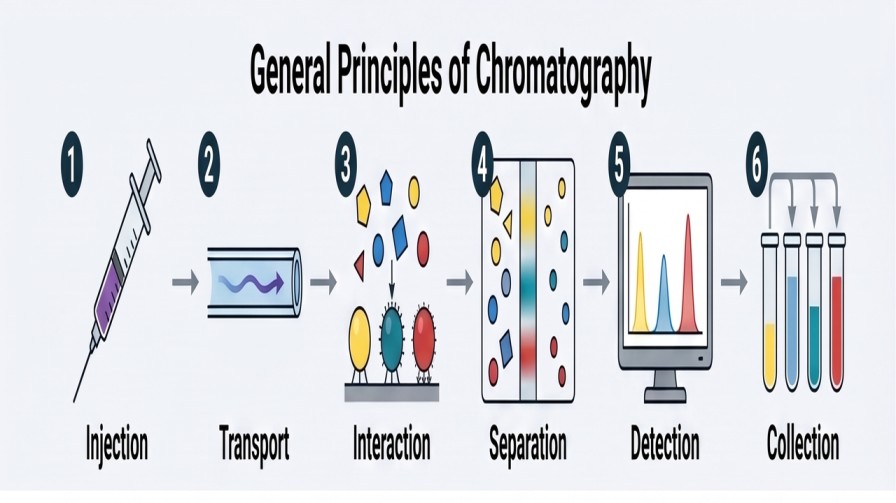
Chromatography separates mixtures based on how strongly each component is attracted to the stationary phase relative to the mobile phase. A component with high affinity for the stationary phase spends more time interacting with it, slows down, and elutes later. A component that prefers the mobile phase partitions less to the stationary phase, moves faster, and elutes earlier. The greater the difference in affinities between two components, the better the resolution.
What Is the Purpose of Chromatography?
Across life science and biomedical research, chromatography fulfills four distinct functional roles. In practice, a single method may serve more than one purpose simultaneously, such as a preparative affinity run that both purifies an antibody and confirms its identity through retention time, but these four pillars define the technique's scope.
Purification
Isolating a target protein, antibody, enzyme, or small molecule from a complex biological matrix — cell lysate, conditioned media, serum, or fermentation broth with sufficient purity for downstream functional assays, structural studies, or therapeutic application. Affinity and ion-exchange steps are the workhorses here.
Browse AAA Biotech's recombinant protein catalog to see how multi-step chromatographic purification translates into defined purity specifications.
Identification
Confirming the identity of a compound based on its retention time under defined conditions, or through coupled detection (UV absorbance profile, mass spectrum, fluorescence signature). Identification by chromatography is both qualitative and comparative, and it locates a component in time and space relative to known standards.
Quantification
Determining the concentration of specific components using peak area or peak height, calibrated against standards of known concentration. In analytical workflows — assay development, pharmacokinetics, and residual solvent analysis are part of quantitative chromatography, which provides the numbers that define product performance and safety.
Quality Control
Verifying that a biological reagent, therapeutic protein, or antibody lot meets defined purity, aggregation, and identity specifications before release. QC chromatography — HPLC purity profiles, SEC aggregation analysis, and IEX charge variant mapping are the gatekeepers between production and use.
Common Types of Chromatography
No single chromatographic technique is universally optimal. The correct method depends on the physicochemical properties of the target, the nature of the matrix, the required purity, the scale of operation, and the downstream application.
Here’s the quick overview:
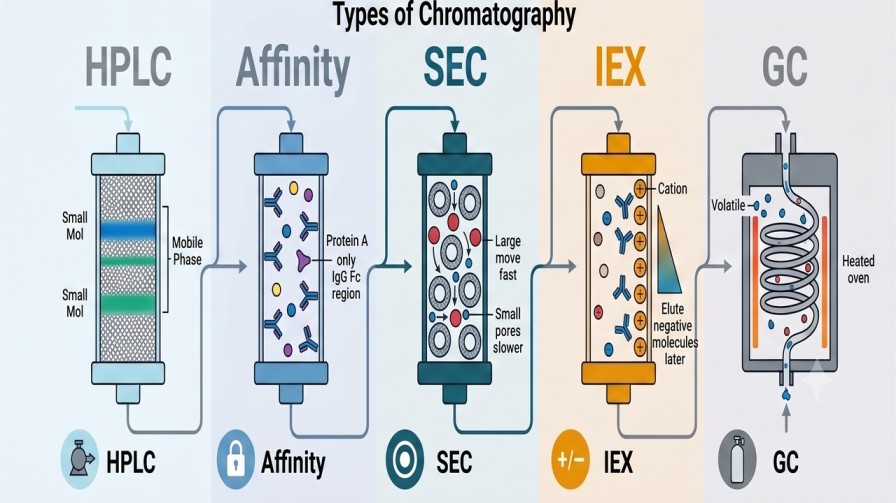
The five techniques below represent the modes most commonly encountered in life science and analytical workflows.
01. High-Performance Liquid Chromatography (HPLC) - For Analytical Standard
A high-pressure pump forces the mobile phase, which is typically an aqueous-organic solvent gradient, through a column packed with small-particle stationary phase material (commonly 1.7–5 μm).
The small particle size maximizes surface area and theoretical plate count, yielding the combination of resolution, speed, and quantitative precision that makes HPLC the benchmark analytical technique across pharmaceutical QC, peptide characterization, and metabolite profiling. Variants including ultra-high-performance LC (UHPLC) and reversed-phase, normal-phase, and hydrophilic interaction modes extend its applicability across a wide polarity range.
02. Affinity Chromatography - For Antibody Purification
Affinity chromatography exploits highly specific biological interactions between a target molecule and an immobilized ligand on the stationary phase. The canonical example is Protein A or Protein G resin, which captures IgG antibodies through the Fc region with dissociation constants in the nanomolar range, thus enabling single-step purification from crude biological fluids with purities exceeding 95%.
His-tag/Ni-NTA, GST/glutathione, and streptavidin/biotin systems extend the principle to recombinant protein workflows. Elution is typically achieved by disrupting the binding interaction through a pH shift or a competitive elution buffer. Affinity chromatography remains the primary isolation method for monoclonal and polyclonal antibodies used in research and diagnostics.
03. Size-Exclusion Chromatography (SEC) - For Biologic QC
SEC separates molecules strictly by hydrodynamic radius with no chemical interaction between the analyte and the stationary phase. The porous matrix acts as a molecular sieve: molecules larger than the largest pore are excluded and elute first in the void volume, while smaller molecules diffuse into and out of pores as they migrate, retarding their elution proportionally.
The result is a size-ordered chromatogram in which aggregates, monomers, and fragments resolve into discrete peaks. SEC is the cornerstone technique for assessing protein aggregation, polydispersity, and molecular weight distribution — all critical parameters in biologic characterization and lot release. When coupled to multi-angle light scattering (SEC-MALS), it yields absolute molecular weight without reliance on protein standards.
04. Ion-Exchange Chromatography (IEX) - For Charge Variants
IEX separates proteins based on differences in net surface charge at a given pH. Cation-exchange (CEX) resins bear a negative charge and bind positively charged proteins; anion-exchange (AEX) resins bear a positive charge and capture negatively charged species.
Elution is accomplished by a salt gradient that competitively displaces bound proteins, or by a pH gradient that shifts protein charge states. IEX is widely used in downstream biopharmaceutical processing for intermediate purification following affinity capture, as well as for charge variant profiling of therapeutic antibodies, an important indicator of product quality and lot-to-lot consistency.
05. Gas Chromatography (GC) - For Small Molecules
In gas chromatography, the mobile phase is an inert carrier gas (helium, nitrogen, or hydrogen) that transports volatile analytes through a heated capillary column coated with a liquid stationary phase. Separation occurs based on differential volatility and interaction with the stationary phase. Analytes must either be inherently volatile or chemically derivatized to be amenable to GC.
In life science contexts, GC is used primarily for residual solvent analysis, lipid profiling, volatile metabolite characterization, and small-molecule forensics. It is not applicable to proteins or antibodies, which are neither volatile nor thermostable at the temperatures required.
Applications in Life Science Research
Chromatography is not a peripheral technique; it is structurally embedded in how life science research generates reliable, quantifiable results. Consider the journey of a recombinant protein from expression to assay: the cell culture supernatant passes through an affinity column for capture, an ion-exchange column for intermediate polishing, and a size-exclusion column for final buffer exchange and aggregation confirmation.
Each step uses chromatography, and each step is necessary for the reagent to perform reproducibly in downstream experiments.
- Protein purification is perhaps the most common application. Whether expressed in E. coli, CHO cells, or insect expression systems, recombinant proteins require at least one chromatographic step and typically two or three in sequence to achieve the purity required for structural studies, binding assays, or functional characterization. His-tag affinity capture followed by SEC polishing is a standard two-step workflow that removes the majority of host-cell proteins, nucleic acid contaminants, and aggregated species.
- Antibody isolation relies almost exclusively on affinity chromatography as the primary capture step. Protein A/G columns bind the constant region of IgG with high selectivity, enabling isolation from complex matrices such as hybridoma supernatant or transgenic animal serum with minimal co-purification of host-derived contaminants. Subsequent IEX and SEC polishing steps address charge variants and high-molecular-weight species, respectively.
- Drug development pipelines deploy chromatography at every stage: characterizing the physicochemical properties of lead candidates, assessing metabolic stability, monitoring pharmacokinetic profiles in biological samples, and ensuring the purity of API batches at milligram-to-gram scale before advancing into formulation. HPLC and LC-MS serve as the primary analytical engines throughout.
- Quality control of biologics imposes rigorous chromatographic requirements before any antibody or recombinant protein lot can be released for use. SEC provides aggregation profiles, HPLC provides purity percentages, and IEX provides charge variant fingerprints — together forming the analytical identity card of every manufactured lot.
The high-grade antibodies and recombinant proteins in the AAA Biotech catalog are subject to exactly these workflows before characterization data is assigned and the product is made available to researchers.
Conclusion
Chromatography underpins every reliable result in life science, from protein purification to drug QC. Mastering its principles, phases, and technique selection equips researchers to make better decisions at every step of the experimental workflow.
Faq's
What factors affect chromatographic resolution?
Resolution depends on three parameters: selectivity (α), plate count (N), and retention factor (k). Selectivity is how differently the stationary phase interacts with two compounds — it has the largest impact and is best adjusted through phase or buffer chemistry. Plate count reflects column efficiency; smaller particles improve it but raise operating pressure. Flow rate, temperature, and gradient slope also affect band broadening and should be evaluated systematically before replacing a column.
How do you choose between isocratic and gradient elution?
Use isocratic when analytes span a narrow interaction range — it's simpler, re-equilibrates faster, and reproduces well across labs. Use gradient elution when the sample contains components with widely varying affinities that can't be resolved at a fixed mobile phase composition. The key trade-off: gradients require defined re-equilibration time between runs, and system dwell volume must be matched when transferring methods between instruments.
What is column dead volume, and why does it matter?
Dead volume is the system volume outside the column — tubing, fittings, injector loops, and detector flow cells. It doesn't contribute to separation; it disperses peaks, degrading resolution. This is negligible in preparative work but critical in UHPLC, where even 5–10 µL of extra-column volume can cause measurable peak broadening. Minimize it with short tubing, low-volume fittings, and matched flow cell sizes. When transferring methods, characterize dwell volume differences to avoid retention time shifts.
Can chromatography assess protein folding or aggregation state?
Yes, Analytical SEC separates monomers from dimers and higher-order aggregates by hydrodynamic radius. SEC-MALS adds multi-angle light scattering to determine absolute molecular weight — useful for glycosylated, elongated, or disordered proteins that don't behave like globular standards. For antibody lot release, the FDA and EMA guidance requires SEC-based aggregation data as part of the product specification. AAA Biotech includes SEC profiles with each catalog product, confirming monomer fraction and absence of high-molecular-weight species.
What is the difference between analytical and preparative chromatography?
Analytical chromatography detects and quantifies — runs at microgram loads, uses narrow-bore columns and sensitive detectors, and sends the sample to waste. Preparative chromatography isolates and recovers material, from milligrams in research purification to kilograms in manufacturing. Preparative columns are wider, accept higher loads, and optimize for yield, purity, and throughput rather than resolution. Scale-up from bench to process requires formal studies to confirm that purity and yield hold across column geometries.
Lead Clinical Research Coordinator (LCRC)
Cynthia Lee is the President of AAA Biotech and specializes in understanding highly validated and characterized monoclonal/polyclonal antibodies, recombinant proteins, and ELISA kits.
Related Posts