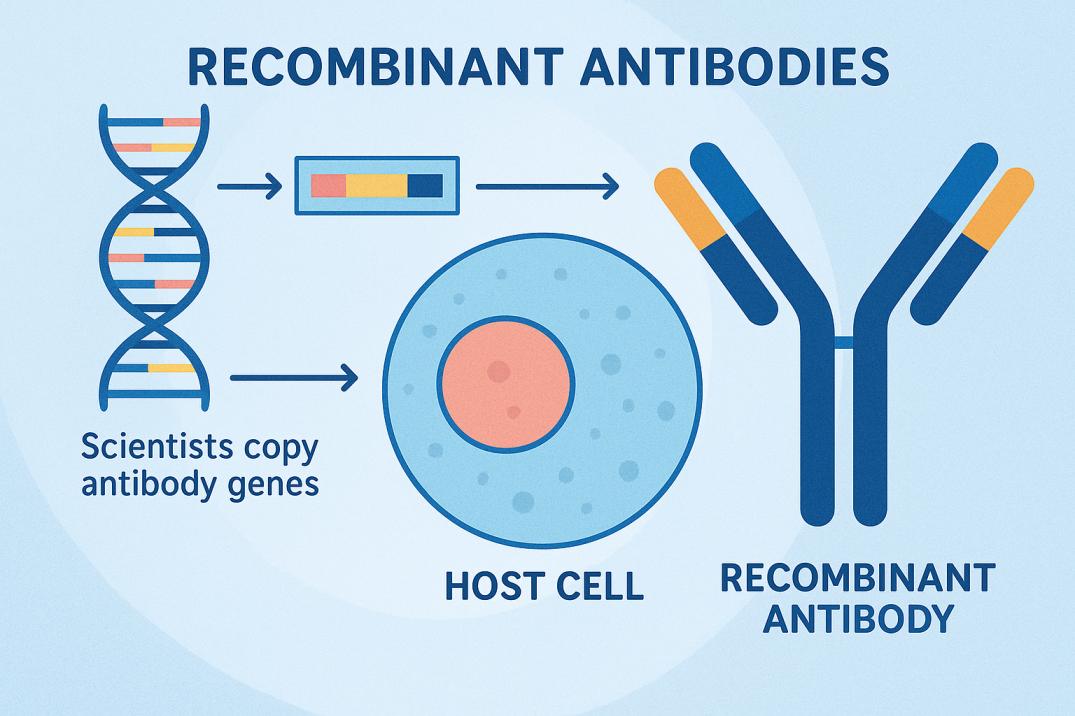
Primary Vs Secondary Antibodies: What's The Difference
 Cynthia
8 min read
Cynthia
8 min read
In this Article
- What Is A Primary Antibody?
- What Is A Secondary Antibody?
- Primary Vs Secondary Antibodies: Side-by-Side Comparison
- Direct Vs. Indirect Detection: Do You Always Need A Secondary Antibody?
- How To Choose A Compatible Primary And Secondary Antibody Pair
- What Are The Most Common Mistakes When Using Primary And Secondary Antibodies?


All of the products listed in AAA Biotech’s catalog are strictly for research-use only (RUO).

Key Takeaways
- Primary antibodies bind directly to the target antigen, while secondary antibodies bind to the primary antibody to detect or amplify the signal.
- Learn the key differences between primary and secondary antibodies through an easy-to-understand comparison table.
- Understand when to use direct versus indirect detection in techniques like Western blot, ELISA, and immunofluorescence.
- Discover how to choose a compatible primary and secondary antibody pair by matching host species, antibody class, and detection method.
- Avoid common antibody selection mistakes that can cause weak signals, high background, and unreliable experimental results.
- Find answers to frequently asked questions about antibody selection, compatibility, storage, and applications.
A primary antibody binds directly to the target antigen. A secondary antibody binds to the primary antibody instead. It helps detect or amplify the signal.
This distinction seems minor, but it matters in practice. A mismatched pairing is a common cause of a weak signal. It also causes a high background in Western blot, ELISA, or IHC. Many researchers focus only on primary antibody quality. But the secondary antibody plays an equally important role. Choosing the wrong host species combination can ruin an assay. Reliable antibody pairing improves reproducibility across experiments and publications. It also reduces wasted reagents and repeated troubleshooting.
This guide breaks down both antibody types clearly. You will see a side-by-side comparison table. You will also learn how to choose a validated, compatible pair for your application. Read on for precise, publication-backed guidance.
What Is A Primary Antibody?

A primary antibody is exactly what it sounds like: the first antibody in the chain. It binds directly to the antigen you're trying to detect, whether that's a protein sitting on a cell surface or a marker buried inside fixed tissue.
Primary antibodies generally come in two forms: monoclonal antibodies and polyclonal antibodies.
- Monoclonal antibodies are engineered to recognize one specific epitope, which makes them highly precise, though sometimes less forgiving if that epitope gets altered during fixation.
- Polyclonal antibodies recognize several epitopes on the same target, giving a stronger, more tolerant signal, occasionally at some cost to specificity.
Did you know? A single primary antibody can be bound by several secondary antibody molecules at once. That's what gives indirect detection its signal-amplifying advantage.
What Is A Secondary Antibody?
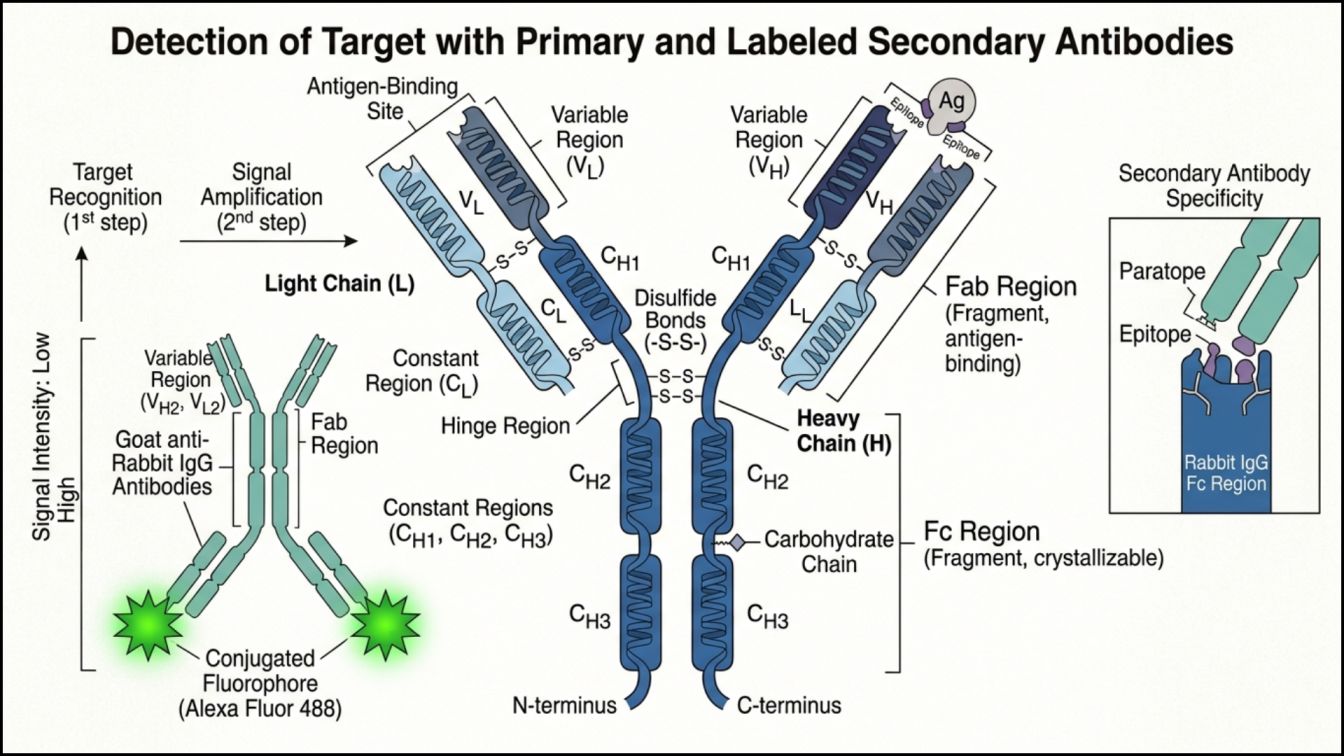
If the primary antibody is the one doing the detective work, the secondary antibody is the megaphone. It doesn't recognize your antigen at all. Instead, it binds to the primary antibody itself, usually at the Fc region, and that's exactly why it works so well.
Secondary antibodies are raised in a host species different from the primary. This keeps them from cross-reacting with the sample's own native immunoglobulins, which would otherwise ruin your results. Most secondary antibodies also carry a conjugate: HRP or AP for colorimetric assays, or a fluorophore for imaging work.
Choosing a secondary antibody isn't just about matching your primary's host species. It also depends on your detection method, your sample type, and whether you're running a single target or a full multiplexed panel.
Primary Vs Secondary Antibodies: Side-by-Side Comparison
If you're wondering, "Which antibody do I actually need for my experiment?" or "What exactly sets them apart?" this side-by-side comparison will help you quickly understand the differences.
| Feature | Primary Antibody | Secondary Antibody |
|---|---|---|
| What it binds to | Target antigen (protein, peptide, or biomolecule) | Fc region of the primary antibody |
| Primary function | Specifically recognizes and binds the target antigen | Detects the primary antibody and generates or amplifies the signal |
| Target specificity | Highly specific to a single antigen or epitope | Specific to the host species and antibody class of the primary antibody |
| Host species | Produced in species such as mouse, rabbit, goat, or rat | Raised against the host species of the primary antibody (e.g., anti-rabbit, anti-mouse) |
| Conjugation | May be unconjugated or directly conjugated | Usually conjugated with enzymes, fluorophores, or biotin |
| Signal amplification | Limited unless conjugated | High, as multiple secondary antibodies can bind one primary antibody |
| Detection method | Direct or indirect detection | Indirect detection only |
| Sensitivity | Lower in direct assays | Higher due to signal amplification |
| Cost | Generally more expensive because each target requires a specific antibody | More cost-effective, as one secondary antibody can be used with multiple primary antibodies from the same host species |
| Reusability | Target-specific; new primary needed for each antigen | Can be reused with different primary antibodies from the same host species |
| Available formats | Monoclonal, polyclonal, recombinant | Mostly polyclonal, with monoclonal options available |
| Typical applications | Western Blot, ELISA, IHC, IF, ICC, Flow Cytometry, IP | Western Blot, ELISA, IHC, IF, ICC, Flow Cytometry (indirect detection) |
| Advantages | High specificity and direct antigen recognition | Greater sensitivity, flexibility, lower cost, and multiple labeling options |
| Limitations | Requires a different antibody for every target; direct labeling can be costly | Risk of cross-reactivity if the wrong secondary antibody is selected |
Direct Vs. Indirect Detection: Do You Always Need A Secondary Antibody?
Not every assay needs a secondary antibody.
- In direct detection, a conjugated primary antibody produces the signal by itself, which cuts out a step and saves time.
- In indirect detection, an unconjugated primary pairs with a labeled secondary antibody instead, and the signal gets amplified since several secondaries bind each primary.
Indirect detection is especially common in multiplex immunofluorescence, where researchers are staining for several targets in the same tissue section at once. Recent work lays out detailed protocols for multiplex panel optimization, including how to pick conjugates and fluorophores that won't overlap or interfere with each other.
Advantages of using secondary antibodies: one primary antibody can pair with several secondary conjugates. That flexibility is what makes cost-effective multiplexing possible in the first place.
How To Choose A Compatible Primary And Secondary Antibody Pair
Choose a compatible primary and secondary antibody pair by matching the primary antibody's host species, immunoglobulin class, antibody format, and detection method. These factors help ensure accurate, specific, and reproducible results while minimizing background and cross-reactivity.
1. Match the Secondary Antibody to the Primary Antibody's Host Species
Start by matching the host species of your primary antibody. The secondary antibody must recognize the species in which the primary antibody was raised.
For example, if your primary antibody was raised in rabbit, you'll need an anti-rabbit secondary antibody. If the species doesn't match, the secondary antibody won't bind, resulting in little or no detectable signal.
| Primary Antibody | Compatible Secondary Antibody |
|---|---|
| Rabbit IgG | Anti-Rabbit IgG |
| Mouse IgG | Anti-Mouse IgG |
| Goat IgG | Anti-Goat IgG |
| Rat IgG | Anti-Rat IgG |
2. Match the Immunoglobulin Class or Subclass
Confirm the immunoglobulin (Ig) class of your primary antibody. Most are IgG, but some are IgM, IgA, or specific subclasses such as IgG1 and IgG2a. A secondary antibody designed for IgG will not reliably detect an IgM primary antibody, so matching the antibody class is just as important as matching the host species.
3. Choose the Right Antibody Format
The antibody format should align with your experimental requirements.
- Whole IgG secondary antibodies are suitable for most routine applications, including Western blotting, ELISA, and immunohistochemistry.
- Fab or F(ab')₂ fragment secondary antibodies lack the Fc region, reducing Fc receptor interactions and minimizing background staining. They are particularly useful for immunofluorescence, multiplex staining, and experiments involving immune cells.
4. Select the Appropriate Conjugate
The conjugate attached to the secondary antibody should match your detection method.
| Application | Recommended Conjugate |
|---|---|
| Western Blot | HRP or Alkaline Phosphatase (AP) |
| ELISA | HRP or AP |
| Immunofluorescence (IF) | Alexa Fluor®, FITC, Cy dyes |
| Flow Cytometry | PE, APC, FITC, Alexa Fluor® |
Enzyme-conjugated antibodies, such as HRP and AP, are commonly used for colorimetric and chemiluminescent detection in Western blotting and ELISA. Fluorophore-conjugated antibodies are better suited for immunofluorescence, flow cytometry, and other imaging-based techniques.
5. Validate Your Antibody Pair
Before starting your experiment, confirm that both antibodies have been validated for your intended application.
Best Practice: Choose antibodies supported by the five-pillar antibody validation framework, an internationally recognized standard developed by the International Working Group for Antibody Validation (IWGAV). Using validated antibodies helps improve experimental accuracy, specificity, and reproducibility.
What Are The Most Common Mistakes When Using Primary And Secondary Antibodies?
The most common mistakes when using primary and secondary antibodies include choosing an incompatible secondary antibody, overlooking cross-reactivity, skipping negative controls, failing to verify antibody compatibility, and ignoring the sample type or antigen state.
Avoiding these errors helps improve specificity, reduce background, and produce reliable, reproducible results.
1. Use a Compatible Secondary Antibody
Always match the secondary antibody to the host species and immunoglobulin class of the primary antibody. An incompatible secondary antibody may fail to bind or produce high background staining.
2. Minimize Cross-Reactivity
In multiplex experiments, using secondary antibodies with overlapping specificities can cause cross-reactivity and make it difficult to distinguish individual targets. Cross-adsorbed secondary antibodies can help improve specificity.
3. Always Include Negative Controls
Negative controls help determine whether the observed signal comes from the target antigen or from non-specific antibody binding. Skipping this step can make experimental results difficult to interpret.
4. Check Antibody Compatibility Before Starting
If you're using an unconjugated primary antibody, make sure you have a compatible secondary antibody available. Also confirm that both antibodies are validated for your intended application.
5. Consider the Antigen State and Sample Type
Choose a primary antibody that has been validated for your sample type. Some antibodies recognize native proteins, while others work only with denatured proteins. Likewise, formalin-fixed, paraffin-embedded (FFPE) tissues often require antigen retrieval before staining.
Final Thought
Primary and secondary antibodies play different, complementary roles in every immunoassay. One finds the target, the other carries the signal. Choosing validated, compatible pairs is what keeps your results clean and reproducible.
Explore our AAA Biotech range of validated antibodies, or reach out if you have questions about pairing the right primary and secondary antibodies for your next experiment.
Faq's
Can a secondary antibody be used without a primary antibody?
No. A secondary antibody cannot bind directly to the target antigen. It is designed to recognize and bind the primary antibody. Without a primary antibody, there is no binding partner, so no specific signal will be generated.
Can one secondary antibody be used with multiple different primary antibodies?
Yes. A single secondary antibody can detect multiple primary antibodies if they are raised in the same host species and belong to the same immunoglobulin class or subclass. This makes secondary antibodies versatile and cost-effective for many experiments.
Is IgG a secondary antibody?
No. IgG is an immunoglobulin (antibody) class, not a type of antibody. Both primary and secondary antibodies can be IgG, depending on how they are produced and their intended role in an immunoassay.
How do I choose primary and secondary antibodies together?
Choose compatible antibodies by matching the primary antibody's host species, immunoglobulin class, and your detection method. Also ensure the secondary antibody has the appropriate conjugate and is validated for your application to achieve reliable, reproducible results.
Is a tertiary antibody the same as a secondary antibody?
No. A tertiary antibody binds to the secondary antibody rather than the primary antibody. It is mainly used in specialized assays to provide additional signal amplification when detecting very low-abundance targets.
Do primary and secondary antibodies need to be stored differently?
Both antibodies should be stored according to the manufacturer's recommendations, typically under refrigerated or frozen conditions. However, fluorophore-conjugated secondary antibodies are light-sensitive and should be protected from light to preserve their performance.
What dilution ratios are typical for primary vs. secondary antibodies?
Primary antibodies are generally used at lower dilutions because they bind directly to the target antigen. Secondary antibodies are often diluted more because multiple secondary antibodies can bind to a single primary antibody, amplifying the signal.
What happens if IgG and IgM are positive?
This question relates to clinical diagnostic testing rather than research antibodies. In infectious disease testing, positive IgM often indicates a recent immune response, while positive IgG usually suggests prior exposure, recovery, or established immunity.
How do primary and secondary antibody responses differ?
This refers to the body's immune response, not laboratory antibodies. A primary immune response occurs after the first exposure to an antigen and develops slowly, while a secondary immune response is faster and stronger due to immune memory.
Lead Clinical Research Coordinator (LCRC)
Cynthia Lee is the President of AAA Biotech and specializes in understanding highly validated and characterized monoclonal/polyclonal antibodies, recombinant proteins, and ELISA kits.
Related Posts