


 IHC (Immunohistchemistry)
(Immunohistochemical analysis of paraffin-embedded liver cancer tissues using CCL2 mouse mAb with DAB staining.)
IHC (Immunohistchemistry)
(Immunohistochemical analysis of paraffin-embedded liver cancer tissues using CCL2 mouse mAb with DAB staining.)
Mouse CCL2 Monoclonal Antibody | anti-CCL2 antibody
Anti-CCL2 Mouse mAb
IHC (Immunohistchemistry)
(Immunohistochemical analysis of paraffin-embedded liver cancer tissues using CCL2 mouse mAb with DAB staining.)
IHC (Immunohistchemistry)
(Immunohistochemical analysis of paraffin-embedded liver cancer tissues using CCL2 mouse mAb with DAB staining.)
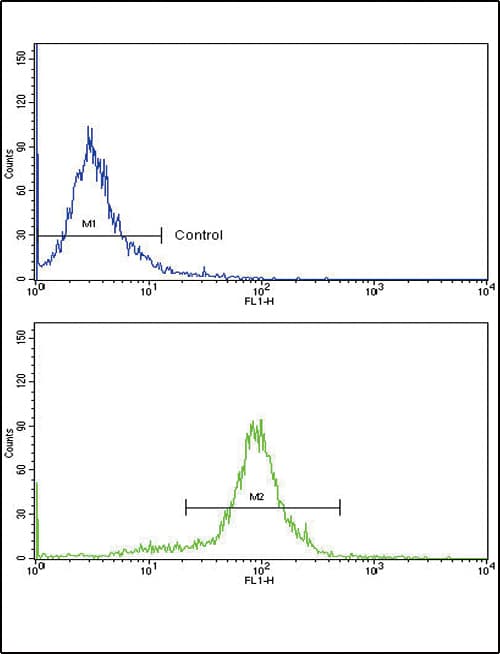
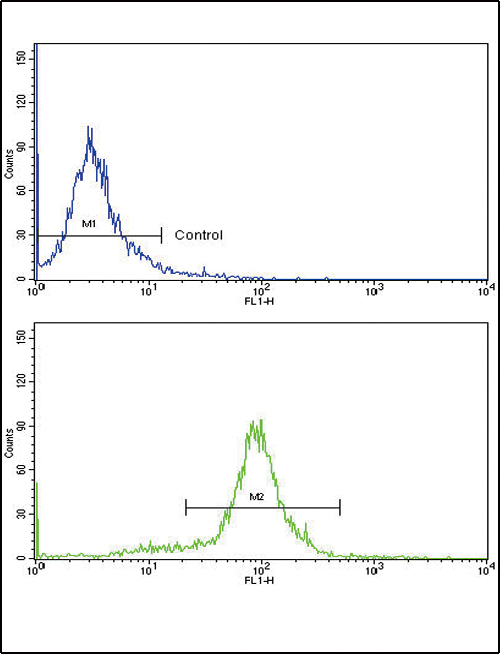
FCM (Flow Cytometry)
(Flow cytometric analysis of A549 cells using CCL2 mouse mAb (green) and negative control (red).)
FCM (Flow Cytometry)
(Flow cytometric analysis of A549 cells using CCL2 mouse mAb (green) and negative control (red).)
IF (Immunofluorescence)
(Immunofluorescence analysis of HepG2 cells using CCL2 mouse mAb (green). Blue)
IF (Immunofluorescence)
(Immunofluorescence analysis of HepG2 cells using CCL2 mouse mAb (green). Blue)
IF (Immunofluorescence)
(Immunofluorescence analysis of HepG2 cells. Blue)
IF (Immunofluorescence)
(Immunofluorescence analysis of HepG2 cells. Blue)
WB (Western Blot)
(Western blot analysis using CCL2 mouse mAb against A549 (1), HeLa (2), Raw264.7 (3), L1210 (4), C6 (5), and COS-7 (6)cell lysate.)
WB (Western Blot)
(Western blot analysis using CCL2 mouse mAb against A549 (1), HeLa (2), Raw264.7 (3), L1210 (4), C6 (5), and COS-7 (6)cell lysate.)
WB (Western Blot)
(Western blot analysis using CCL2 mAb against human CCL2 (AA)
WB (Western Blot)
(Western blot analysis using CCL2 mAb against human CCL2 (AA)
NCBI and Uniprot Product Information
Customer Reviews
Loading reviews...
Share Your Experience
Similar Products


Product Notes
The CCL2 ccl2 (Catalog #AAA14116) is an Antibody produced from Mouse and is intended for research purposes only. The product is available for immediate purchase. The Anti-CCL2 Mouse mAb reacts with Human, Mouse, Monkey and may cross-react with other species as described in the data sheet. AAA Biotech's CCL2 can be used in a range of immunoassay formats including, but not limited to, WB (Western Blot), IHC (Immunohistochemistry), ICC (Immunocytochemistry), FCM/FACS (Flow Cytometry). Researchers should empirically determine the suitability of the CCL2 ccl2 for an application not listed in the data sheet. Researchers commonly develop new applications and it is an integral, important part of the investigative research process. It is sometimes possible for the material contained within the vial of "CCL2, Monoclonal Antibody" to become dispersed throughout the inside of the vial, particularly around the seal of said vial, during shipment and storage. We always suggest centrifuging these vials to consolidate all of the liquid away from the lid and to the bottom of the vial prior to opening. Please be advised that certain products may require dry ice for shipping and that, if this is the case, an additional dry ice fee may also be required.Precautions
All products in the AAA Biotech catalog are strictly for research-use only, and are absolutely not suitable for use in any sort of medical, therapeutic, prophylactic, in-vivo, or diagnostic capacity. By purchasing a product from AAA Biotech, you are explicitly certifying that said products will be properly tested and used in line with industry standard. AAA Biotech and its authorized distribution partners reserve the right to refuse to fulfill any order if we have any indication that a purchaser may be intending to use a product outside of our accepted criteria.Disclaimer
Though we do strive to guarantee the information represented in this datasheet, AAA Biotech cannot be held responsible for any oversights or imprecisions. AAA Biotech reserves the right to adjust any aspect of this datasheet at any time and without notice. It is the responsibility of the customer to inform AAA Biotech of any product performance issues observed or experienced within 30 days of receipt of said product. To see additional details on this or any of our other policies, please see our Terms & Conditions page.Frequently Asked Questions
What does CCL2 indicate in research or disease studies?
CCL2, also known as Monocyte Chemoattractant Protein-1 (MCP-1), indicates the presence of an inflammatory response. It is a potent chemokine that recruits monocytes, memory T cells, and dendritic cells to sites of tissue injury or infection. High levels of CCL2 are often associated with chronic inflammatory diseases, atherosclerosis, and certain types of cancer progression.
What are the common uses of mouse monoclonal antibodies?
Mouse monoclonal antibodies are commonly used in research for high-specificity detection of antigens in various assays. For CCL2 specifically, they are utilized in ELISA for protein quantification, Western Blotting for detection, and neutralization assays to block the chemokine's biological activity in vivo or in vitro, helping researchers understand its role in inflammatory signaling.
Which gene encodes CCL2 in mice?
In mice, the Ccl2 gene (sometimes referred to as the Je gene) encodes the CCL2 protein. This gene is located on chromosome 11 and is induced by various stimuli, including growth factors and cytokines. Studying this gene helps researchers understand the transcriptional regulation of the inflammatory response in murine models of disease.
What are the main classes of monoclonal antibodies?
Monoclonal antibodies are primarily classified by their isotype, such as IgG1, IgG2a, IgG2b, IgG3, and IgM. These classes differ in their structure and ability to trigger various immune effector functions, such as complement activation or binding to Fc receptors. AAA Biotech offers various isotypes to suit different experimental requirements, such as functional blocking or detection.
How is CCL2 used as a biomarker in experiments?
In experiments, CCL2 is used as a biomarker to measure the degree of inflammation or immune cell infiltration. Researchers quantify CCL2 levels in serum, plasma, or tissue supernatants to monitor disease severity or the effectiveness of anti-inflammatory treatments. Its presence often correlates with the recruitment of macrophages to lesion sites in disease models.
What distinguishes different types of monoclonal antibodies?
Different types of monoclonal antibodies are distinguished by their clone origin, host species, and isotype. Each clone binds to a specific epitope with a unique affinity. Furthermore, antibodies can be "recombinant," which ensures high purity and consistency. Choosing the right type depends on whether the goal is cell gating in flow cytometry, tissue staining, or neutralizing a protein's function.
Item has been added to Shopping Cart
If you are ready to order, navigate to Shopping Cart and get ready to checkout.