
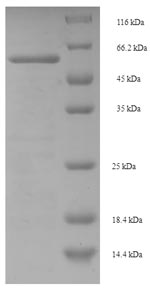
 SDS-PAGE
DNA mismatch repair protein Msh6 Recombinant Protein | MSH6 recombinant protein
Recombinant Human DNA mismatch repair protein Msh6
Gene Names
MSH6; GTBP; HSAP; p160; GTMBP; HNPCC5
Purity
Greater or equal to 85% purity as determined by SDS-PAGE.
Synonyms
DNA mismatch repair protein Msh6; N/A; Recombinant Human DNA mismatch repair protein Msh6; G/T mismatch-binding protein; GTBP; GTMBP; MutS-alpha 160 kDa subunit; p160; MSH6 recombinant protein
Host
E Coli or Yeast or Baculovirus or Mammalian Cell
Purity/Purification
Greater or equal to 85% purity as determined by SDS-PAGE.
Form/Format
Lyophilized or liquid (Format to be determined during the manufacturing process)
Sequence Positions
1-400aa; Partial
Sequence
MSRQSTLYSF FPKSPALSDA NKASARASRE GGRAAAAPGA SPSPGGDAAW SEAGPGPRPL ARSASPPKAK NLNGGLRRSV APAAPTSCDF SPGDLVWAKM EGYPWWPCLV YNHPFDGTFI REKGKSVRVH VQFFDDSPTR GWVSKRLLKP YTGSKSKEAQ KGGHFYSAKP EILRAMQRAD EALNKDKIKR LELAVCDEPS EPEEEEEMEV GTTYVTDKSE EDNEIESEEE VQPKTQGSRR SSRQIKKRRV ISDSESDIGG SDVEFKPDTK EEGSSDEISS GVGDSESEGL NSPVKVARKR KRMVTGNGSL KRKSSRKETP SATKQATSIS SETKNTLRAF SAPQNSESQA HVSGGGDDSS RPTVWYHETL EWLKEEKRRD EHRRRPDHPD FDASTLYVPE
Sequence Length
1360
Preparation and Storage
Store at -20 degree C, for extended storage, conserve at -20 degree C or -80 degree C.
SDS-PAGE
SDS-PAGE
Related Product Information for MSH6 recombinant protein
Component of the post-replicative DNA mismatch repair system (MMR). Heterodimerizes with MSH2 to form MutS alpha, which binds to DNA mismatches thereby initiating DNA repair. When bound, MutS alpha bends the DNA helix and shields approximately 20 base pairs, and recognizes single base mismatches and dinucleotide insertion-deletion loops (IDL) in the DNA. After mismatch binding, forms a ternary complex with the MutL alpha heterodimer, which is thought to be responsible for directing the downstream MMR events, including strand discrimination, excision, and resynthesis. ATP binding and hydrolysis play a pivotal role in mismatch repair functions. The ATPase activity associated with MutS alpha regulates binding similar to a molecular switch: mismatched DNA provokes ADP-->ATP exchange, resulting in a discernible conformational transition that converts MutS alpha into a sliding clamp capable of hydrolysis-independent diffusion along the DNA backbone. This transition is crucial for mismatch repair. MutS alpha may also play a role in DNA homologous recombination repair. Recruited on chromatin in G1 and early S phase via its PWWP domain that specifically binds trimethylated 'Lys-36' of histone H3 (H3K36me3): early recruitment to chromatin to be replicated allowing a quick identification of mismatch repair to initiate the DNA mismatch repair reaction
Product Categories/Family for MSH6 recombinant protein
References
hMSH2 forms specific mispair-binding complexes with hMSH3 and hMSH6.Acharya S., Wilson T., Gradia S., Kane M.F., Guerrette S., Marsischky G.T., Kolodner R.D., Fishel R.Proc. Natl. Acad. Sci. U.S.A. 93:13629-13634(1996) Alternative splicing of GTBP in normal human tissues.Shiwaku H.O., Wakatsuki S., Mori Y., Fukushige S., Horii A.DNA Res. 4:359-362(1997) Complete sequencing and characterization of 21,243 full-length human cDNAs.Ota T., Suzuki Y., Nishikawa T., Otsuki T., Sugiyama T., Irie R., Wakamatsu A., Hayashi K., Sato H., Nagai K., Kimura K., Makita H., Sekine M., Obayashi M., Nishi T., Shibahara T., Tanaka T., Ishii S., Yamamoto J., Saito K., Kawai Y., Isono Y., Nakamura Y., Nagahari K., Murakami K., Yasuda T., Iwayanagi T., Wagatsuma M., Shiratori A., Sudo H., Hosoiri T., Kaku Y., Kodaira H., Kondo H., Sugawara M., Takahashi M., Kanda K., Yokoi T., Furuya T., Kikkawa E., Omura Y., Abe K., Kamihara K., Katsuta N., Sato K., Tanikawa M., Yamazaki M., Ninomiya K., Ishibashi T., Yamashita H., Murakawa K., Fujimori K., Tanai H., Kimata M., Watanabe M., Hiraoka S., Chiba Y., Ishida S., Ono Y., Takiguchi S., Watanabe S., Yosida M., Hotuta T., Kusano J., Kanehori K., Takahashi-Fujii A., Hara H., Tanase T.-O., Nomura Y., Togiya S., Komai F., Hara R., Takeuchi K., Arita M., Imose N., Musashino K., Yuuki H., Oshima A., Sasaki N., Aotsuka S., Yoshikawa Y., Matsunawa H., Ichihara T., Shiohata N., Sano S., Moriya S., Momiyama H., Satoh N., Takami S., Terashima Y., Suzuki O., Nakagawa S., Senoh A., Mizoguchi H., Goto Y., Shimizu F., Wakebe H., Hishigaki H., Watanabe T., Sugiyama A., Takemoto M., Kawakami B., Yamazaki M., Watanabe K., Kumagai A., Itakura S., Fukuzumi Y., Fujimori Y., Komiyama M., Tashiro H., Tanigami A., Fujiwara T., Ono T., Yamada K., Fujii Y., Ozaki K., Hirao M., Ohmori Y., Kawabata A., Hikiji T., Kobatake N., Inagaki H., Ikema Y., Okamoto S., Okitani R., Kawakami T., Noguchi S., Itoh T., Shigeta K., Senba T., Matsumura K., Nakajima Y., Mizuno T., Morinaga M., Sasaki M., Togashi T., Oyama M., Hata H., Watanabe M., Komatsu T., Mizushima-Sugano J., Satoh T., Shirai Y., Takahashi Y., Nakagawa K., Okumura K., Nagase T., Nomura N., Kikuchi H., Masuho Y., Yamashita R., Nakai K., Yada T., Nakamura Y., Ohara O., Isogai T., Sugano S.Nat. Genet. 36:40-45(2004) NIEHS SNPs programGeneration and annotation of the DNA sequences of human chromosomes 2 and 4.Hillier L.W., Graves T.A., Fulton R.S., Fulton L.A., Pepin K.H., Minx P., Wagner-McPherson C., Layman D., Wylie K., Sekhon M., Becker M.C., Fewell G.A., Delehaunty K.D., Miner T.L., Nash W.E., Kremitzki C., Oddy L., Du H., Sun H., Bradshaw-Cordum H., Ali J., Carter J., Cordes M., Harris A., Isak A., van Brunt A., Nguyen C., Du F., Courtney L., Kalicki J., Ozersky P., Abbott S., Armstrong J., Belter E.A., Caruso L., Cedroni M., Cotton M., Davidson T., Desai A., Elliott G., Erb T., Fronick C., Gaige T., Haakenson W., Haglund K., Holmes A., Harkins R., Kim K., Kruchowski S.S., Strong C.M., Grewal N., Goyea E., Hou S., Levy A., Martinka S., Mead K., McLellan M.D., Meyer R., Randall-Maher J., Tomlinson C., Dauphin-Kohlberg S., Kozlowicz-Reilly A., Shah N., Swearengen-Shahid S., Snider J., Strong J.T., Thompson J., Yoakum M., Leonard S., Pearman C., Trani L., Radionenko M., Waligorski J.E., Wang C., Rock S.M., Tin-Wollam A.-M., Maupin R., Latreille P., Wendl M.C., Yang S.-P., Pohl C., Wallis J.W., Spieth J., Bieri T.A., Berkowicz N., Nelson J.O., Osborne J., Ding L., Meyer R., Sabo A., Shotland Y., Sinha P., Wohldmann P.E., Cook L.L., Hickenbotham M.T., Eldred J., Williams D., Jones T.A., She X., Ciccarelli F.D., Izaurralde E., Taylor J., Schmutz J., Myers R.M., Cox D.R., Huang X., McPherson J.D., Mardis E.R., Clifton S.W., Warren W.C., Chinwalla A.T., Eddy S.R., Marra M.A., Ovcharenko I., Furey T.S., Miller W., Eichler E.E., Bork P., Suyama M., Torrents D., Waterston R.H., Wilson R.K.Nature 434:724-731(2005) GTBP, a 160-kilodalton protein essential for mismatch-binding activity in human cells.Palombo F., Gallinari P., Iaccarino I., Lettieri T., Hughes M., D'Arrigo A., Truong O., Hsuan J.J., Jiricny J.Science 268:1912-1914(1995) Molecular cloning of the N-terminus of GTBP.Nicolaides N.C., Palombo F., Kinzler K.W., Vogelstein B., Jiricny J.Genomics 31:395-397(1996) Isolation of an hMSH2-p160 heterodimer that restores DNA mismatch repair to tumor cells.Drummond J.T., Li G.-M., Longley M.J., Modrich P.Science 268:1909-1912(1995) Nucleotide-promoted release of hMutSalpha from heteroduplex DNA is consistent with an ATP-dependent translocation mechanism.Blackwell L.J., Martik D., Bjornson K.P., Bjornson E.S., Modrich P.J. Biol. Chem. 273:32055-32062(1998) DNA-dependent activation of the hMutSalpha ATPase.Blackwell L.J., Bjornson K.P., Modrich P.J. Biol. Chem. 273:32049-32054(1998) hMSH2 and hMSH6 play distinct roles in mismatch binding and contribute differently to the ATPase activity of hMutSalpha.Iaccarino I., Marra G., Palombo F., Jiricny J.EMBO J. 17:2677-2686(1998) Functional analysis of human MutSalpha and MutSbeta complexes in yeast.Clark A.B., Cook M.E., Tran H.T., Gordenin D.A., Resnick M.A., Kunkel T.A.Nucleic Acids Res. 27:736-742(1999) hMSH2-hMSH6 forms a hydrolysis-independent sliding clamp on mismatched DNA.Gradia S., Subramanian D., Wilson T., Acharya S., Makhov A., Griffith J., Fishel R.Mol. Cell 3:255-261(1999) The role of mismatched nucleotides in activating the hMSH2-hMSH6 molecular switch.Gradia S., Acharya S., Fishel R.J. Biol. Chem. 275:3922-3930(2000) The mismatch DNA repair heterodimer, hMSH2/6, regulates BLM helicase.Yang Q., Zhang R., Wang X.W., Linke S.P., Sengupta S., Hickson I.D., Pedrazzi G., Perrera C., Stagljar I., Littman S.J., Modrich P., Harris C.C.Oncogene 23:3749-3756(2004) hMutS alpha is protected from ubiquitin-proteasome-dependent degradation by atypical protein kinase C zeta phosphorylation.Hernandez-Pigeon H., Quillet-Mary A., Louat T., Schambourg A., Humbert O., Selves J., Salles B., Laurent G., Lautier D.J. Mol. Biol. 348:63-74(2005) BASC, a super complex of BRCA1-associated proteins involved in the recognition and repair of aberrant DNA structures.Wang Y., Cortez D., Yazdi P., Neff N., Elledge S.J., Qin J.Genes Dev. 14:927-939(2000) Germline mutation of MSH6 as the cause of hereditary nonpolyposis colorectal cancer.Miyaki M., Konishi M., Tanaka K., Kikuchi-Yanoshita R., Muraoka M., Yasuno M., Igari T., Koike M., Chiba M., Mori T.Nat. Genet. 17:271-272(1997) Global, in vivo, and site-specific phosphorylation dynamics in signaling networks.Olsen J.V., Blagoev B., Gnad F., Macek B., Kumar C., Mortensen P., Mann M.Cell 127:635-648(2006) A probability-based approach for high-throughput protein phosphorylation analysis and site localization.Beausoleil S.A., Villen J., Gerber S.A., Rush J., Gygi S.P.Nat. Biotechnol. 24:1285-1292(2006) Novel biallelic mutations in MSH6 and PMS2 genes gene conversion as a likely cause of PMS2 gene inactivation.Auclair J., Leroux D., Desseigne F., Lasset C., Saurin J.C., Joly M.O., Pinson S., Xu X.L., Montmain G., Ruano E., Navarro C., Puisieux A., Wang Q.Hum. Mutat. 28:1084-1090(2007) ATM and ATR substrate analysis reveals extensive protein networks responsive to DNA damage.Matsuoka S., Ballif B.A., Smogorzewska A., McDonald E.R. III, Hurov K.E., Luo J., Bakalarski C.E., Zhao Z., Solimini N., Lerenthal Y., Shiloh Y., Gygi S.P., Elledge S.J.Science 316:1160-1166(2007) Combining protein-based IMAC, peptide-based IMAC, and MudPIT for efficient phosphoproteomic analysis.Cantin G.T., Yi W., Lu B., Park S.K., Xu T., Lee J.-D., Yates J.R. IIIJ. Proteome Res. 7:1346-1351(2008) Kinase-selective enrichment enables quantitative phosphoproteomics of the kinome across the cell cycle.Daub H., Olsen J.V., Bairlein M., Gnad F., Oppermann F.S., Korner R., Greff Z., Keri G., Stemmann O., Mann M.Mol. Cell 31:438-448(2008) A quantitative atlas of mitotic phosphorylation.Dephoure N., Zhou C., Villen J., Beausoleil S.A., Bakalarski C.E., Elledge S.J., Gygi S.P.Proc. Natl. Acad. Sci. U.S.A. 105:10762-10767(2008) Lysine acetylation targets protein complexes and co-regulates major cellular functions.Choudhary C., Kumar C., Gnad F., Nielsen M.L., Rehman M., Walther T.C., Olsen J.V., Mann M.Science 325:834-840(2009) Quantitative phosphoproteomics reveals widespread full phosphorylation site occupancy during mitosis.Olsen J.V., Vermeulen M., Santamaria A., Kumar C., Miller M.L., Jensen L.J., Gnad F., Cox J., Jensen T.S., Nigg E.A., Brunak S., Mann M.Sci. Signal. 3:RA3-RA3(2010) Initial characterization of the human central proteome.Burkard T.R., Planyavsky M., Kaupe I., Breitwieser F.P., Buerckstuemmer T., Bennett K.L., Superti-Furga G., Colinge J.BMC Syst. Biol. 5:17-17(2011) DNA mismatch repair proteins are required for efficient herpes simplex virus 1 replication.Mohni K.N., Mastrocola A.S., Bai P., Weller S.K., Heinen C.D.J. Virol. 85:12241-12253(2011) System-wide temporal characterization of the proteome and phosphoproteome of human embryonic stem cell differentiation.Rigbolt K.T., Prokhorova T.A., Akimov V., Henningsen J., Johansen P.T., Kratchmarova I., Kassem M., Mann M., Olsen J.V., Blagoev B.Sci. Signal. 4:RS3-RS3(2011) The histone mark H3K36me3 regulates human DNA mismatch repair through its interaction with MutSalpha.Li F., Mao G., Tong D., Huang J., Gu L., Yang W., Li G.M.Cell 153:590-600(2013) Structure of the human MutSalpha DNA lesion recognition complex.Warren J.J., Pohlhaus T.J., Changela A., Iyer R.R., Modrich P.L., Beese L.S.Mol. Cell 26:579-592(2007) Mutations of GTBP in genetically unstable cells.Papadopoulos N., Nicolaides N.C., Liu B., Parsons R., Lengauer C., Palombo F., D'Arrigo A., Markowitz S., Willson J.K.V., Kinzler K.W., Jiricny J., Vogelstein B.Science 268:1915-1917(1995) Association of hereditary nonpolyposis colorectal cancer-related tumors displaying low microsatellite instability with MSH6 germline mutations.Wu Y., Berends M.J.W., Mensink R.G.J., Kempinga C., Sijmons R.H., van Der Zee A.G.J., Hollema H., Kleibeuker J.H., Buys C.H.C.M., Hofstra R.M.W.Am. J. Hum. Genet. 65:1291-1298(1999) Germ-line msh6 mutations in colorectal cancer families.Kolodner R.D., Tytell J.D., Schmeits J.L., Kane M.F., Das Gupta R., Weger J., Wahlberg S., Fox E.A., Peel D., Ziogas A., Garber J.E., Syngal S., Anton-Culver H., Li F.P.Cancer Res. 59:5068-5074(1999) Prevalence of germline mutations of hMLH1, hMSH2, hPMS1, hPMS2, and hMSH6 genes in 75 French kindreds with nonpolyposis colorectal cancer.Wang Q., Lasset C., Desseigne F., Saurin J.-C., Maugard C., Navarro C., Ruano E., Descos L., Trillet-Lenoir V., Bosset J.-F., Puisieux A.Hum. Genet. 105:79-85(1999) Frequent microsatellite instability and mismatch repair gene mutations in young Chinese patients with colorectal cancer.Chan T.L., Yuen S.T., Chung L.P., Ho J.W.C., Kwan K.Y.M., Chan A.S.Y., Ho J.C.Y., Leung S.Y., Wyllie A.H.J. Natl. Cancer Inst. 91:1221-1226(1999) Do MSH6 mutations contribute to double primary cancers of the colorectum and endometrium?Charames G.S., Millar A.L., Pal T., Narod S., Bapat B.Hum. Genet. 107:623-629(2000) Sequence analysis of the mismatch repair gene hMSH6 in the germline of patients with familial and sporadic colorectal cancer.Plaschke J., Kruppa C., Tischler R., Bocker T., Pistorius S., Dralle H., Rueschoff J., Saeger H.D., Fishel R., Schackert H.K.3.0.CO;2-B>Int. J. Cancer 85:606-613(2000) Germline and somatic mutations in hMSH6 and hMSH3 in gastrointestinal cancers of the microsatellite mutator phenotype.Ohmiya N., Matsumoto S., Yamamoto H., Baranovskaya S., Malkhosyan S.R., Perucho M.Gene 272:301-313(2001) A role for MLH3 in hereditary nonpolyposis colorectal cancer.Wu Y., Berends M.J.W., Sijmons R.H., Mensink R.G.J., Verlind E., Kooi K.A., van der Sluis T., Kempinga C., van der Zee A.G.J., Hollema H., Buys C.H.C.M., Kleibeuker J.H., Hofstra R.M.W.Nat. Genet. 29:137-138(2001) Molecular and clinical characteristics of MSH6 variants an analysis of 25 index carriers of a germline variant.Berends M.J.W., Wu Y., Sijmons R.H., Mensink R.G.J., van der Sluis T., Hordijk-Hos J.M., de Vries E.G.E., Hollema H., Karrenbeld A., Buys C.H.C.M., van der Zee A.G.J., Hofstra R.M.W., Kleibeuker J.H.Am. J. Hum. Genet. 70:26-37(2002) Involvement of hMSH6 in the development of hereditary and sporadic colorectal cancer revealed by immunostaining is based on germline mutations, but rarely on somatic inactivation.Plaschke J., Krueger S., Pistorius S., Theissig F., Saeger H.D., Schackert H.K.Int. J. Cancer 97:643-648(2002) Molecular analysis of hereditary nonpolyposis colorectal cancer in the United States high mutation detection rate among clinically selected families and characterization of an American founder genomic deletion of the MSH2 gene.Wagner A., Barrows A., Wijnen J.T., van der Klift H., Franken P.F., Verkuijlen P., Nakagawa H., Geugien M., Jaghmohan-Changur S., Breukel C., Meijers-Heijboer H., Morreau H., van Puijenbroek M., Burn J., Coronel S., Kinarski Y., Okimoto R., Watson P., Lynch J.F., de la Chapelle A., Lynch H.T., Fodde R.Am. J. Hum. Genet. 72:1088-1100(2003) Two mismatch repair gene mutations found in a colon cancer patient - which one is pathogenic?Kariola R., Otway R., Loennqvist K.E., Raevaara T.E., Macrae F., Vos Y.J., Kohonen-Corish M., Hofstra R.M.W., Nystroem-Lahti M.Hum. Genet. 112:105-109(2003) MSH6 germline mutations are rare in colorectal cancer families.Peterlongo P., Nafa K., Lerman G.S., Glogowski E., Shia J., Ye T.Z., Markowitz A.J., Guillem J.G., Kolachana P., Boyd J.A., Offit K., Ellis N.A.Int. J. Cancer 107:571-579(2003) MSH6 missense mutations are often associated with no or low cancer susceptibility.Kariola R., Hampel H., Frankel W.L., Raevaara T.E., de la Chapelle A., Nystroem-Lahti M.Br. J. Cancer 91:1287-1292(2004) Eight novel MSH6 germline mutations in patients with familial and nonfamilial colorectal cancer selected by loss of protein expression in tumor tissue.The German HNPCC consortiumPlaschke J., Krueger S., Dietmaier W., Gebert J., Sutter C., Mangold E., Pagenstecher C., Holinski-Feder E., Schulmann K., Moeslein G., Rueschoff J., Engel C., Evans G., Schackert H.K.Hum. Mutat. 23:285-285(2004) Germline mutations in MLH1, MSH2 and MSH6 in Korean hereditary non-polyposis colorectal cancer families.Shin Y.-K., Heo S.-C., Shin J.-H., Hong S.-H., Ku J.-L., Yoo B.-C., Kim I.-J., Park J.-G.Hum. Mutat. 24:351-351(2004) Mutation analysis of the MLH1, MSH2 and MSH6 genes in patients with double primary cancers of the colorectum and the endometrium a population-based study in northern Sweden.Cederquist K., Emanuelsson M., Goeransson I., Holinski-Feder E., Mueller-Koch Y., Golovleva I., Groenberg H.Int. J. Cancer 109:370-376(2004) Lower incidence of colorectal cancer and later age of disease onset in 27 families with pathogenic MSH6 germline mutations compared with families with MLH1 or MSH2 mutations the German hereditary nonpolyposis colorectal cancer consortium.Plaschke J., Engel C., Krueger S., Holinski-Feder E., Pagenstecher C., Mangold E., Moeslein G., Schulmann K., Gebert J., von Knebel Doeberitz M., Rueschoff J., Loeffler M., Schackert H.K.J. Clin. Oncol. 22:4486-4494(2004) Patterns of somatic mutation in human cancer genomes.Greenman C., Stephens P., Smith R., Dalgliesh G.L., Hunter C., Bignell G., Davies H., Teague J., Butler A., Stevens C., Edkins S., O'Meara S., Vastrik I., Schmidt E.E., Avis T., Barthorpe S., Bhamra G., Buck G., Choudhury B., Clements J., Cole J., Dicks E., Forbes S., Gray K., Halliday K., Harrison R., Hills K., Hinton J., Jenkinson A., Jones D., Menzies A., Mironenko T., Perry J., Raine K., Richardson D., Shepherd R., Small A., Tofts C., Varian J., Webb T., West S., Widaa S., Yates A., Cahill D.P., Louis D.N., Goldstraw P., Nicholson A.G., Brasseur F., Looijenga L., Weber B.L., Chiew Y.-E., DeFazio A., Greaves M.F., Green A.R., Campbell P., Birney E., Easton D.F., Chenevix-Trench G., Tan M.-H., Khoo S.K., Teh B.T., Yuen S.T., Leung S.Y., Wooster R., Futreal P.A., Stratton M.R.Nature 446:153-158(2007) Classification of ambiguous mutations in DNA mismatch repair genes identified in a population-based study of colorectal cancer.Barnetson R.A., Cartwright N., van Vliet A., Haq N., Drew K., Farrington S., Williams N., Warner J., Campbell H., Porteous M.E., Dunlop M.G.Hum. Mutat. 29:367-374(2008) A rapid and cell-free assay to test the activity of lynch syndrome-associated MSH2 and MSH6 missense variants.Drost M., Zonneveld J.B., van Hees S., Rasmussen L.J., Hofstra R.M., de Wind N.Hum. Mutat. 33:488-494(2012) Mismatch repair analysis of inherited MSH2 and/or MSH6 variation pairs found in cancer patients.Kantelinen J., Kansikas M., Candelin S., Hampel H., Smith B., Holm L., Kariola R., Nystrom M.Hum. Mutat. 33:1294-1301(2012) +Additional computationally mapped references.<p>Provides general information on the entry.
NCBI and Uniprot Product Information
NCBI GI #
NCBI GeneID
NCBI Accession #
NCBI GenBank Nucleotide #
Molecular Weight
60.1 kDa
NCBI Official Full Name
DNA mismatch repair protein Msh6 isoform 1
NCBI Official Synonym Full Names
mutS homolog 6
NCBI Official Symbol
MSH6
NCBI Official Synonym Symbols
GTBP; HSAP; p160; GTMBP; HNPCC5
NCBI Protein Information
DNA mismatch repair protein Msh6
UniProt Protein Name
DNA mismatch repair protein Msh6
UniProt Gene Name
MSH6
UniProt Synonym Gene Names
GTBP; hMSH6; GTBP; GTMBP; p160
UniProt Entry Name
MSH6_HUMAN
Customer Reviews
Loading reviews...
Share Your Experience
Similar Products



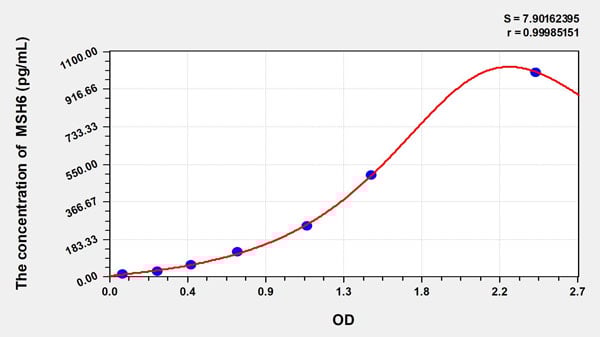
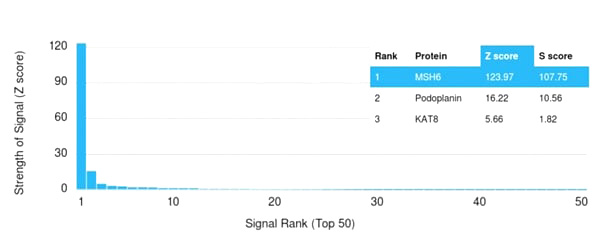
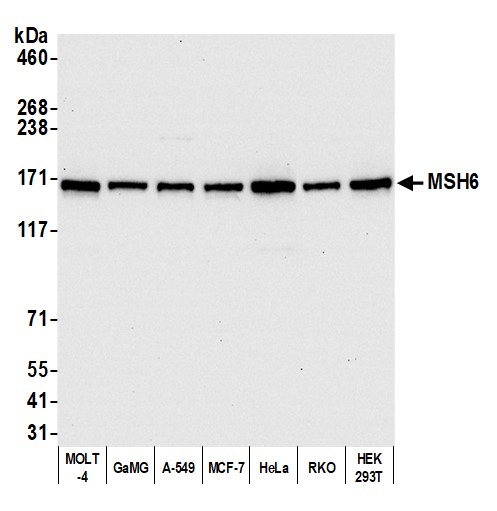
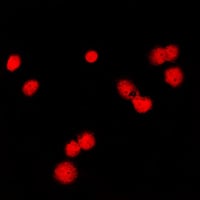
Product Notes
The MSH6 msh6 (Catalog #AAA113627) is a Recombinant Protein produced from E Coli or Yeast or Baculovirus or Mammalian Cell and is intended for research purposes only. The product is available for immediate purchase. The immunogen sequence is 1-400aa; Partial. The amino acid sequence is listed below: MSRQSTLYSF FPKSPALSDA NKASARASRE GGRAAAAPGA SPSPGGDAAW SEAGPGPRPL ARSASPPKAK NLNGGLRRSV APAAPTSCDF SPGDLVWAKM EGYPWWPCLV YNHPFDGTFI REKGKSVRVH VQFFDDSPTR GWVSKRLLKP YTGSKSKEAQ KGGHFYSAKP EILRAMQRAD EALNKDKIKR LELAVCDEPS EPEEEEEMEV GTTYVTDKSE EDNEIESEEE VQPKTQGSRR SSRQIKKRRV ISDSESDIGG SDVEFKPDTK EEGSSDEISS GVGDSESEGL NSPVKVARKR KRMVTGNGSL KRKSSRKETP SATKQATSIS SETKNTLRAF SAPQNSESQA HVSGGGDDSS RPTVWYHETL EWLKEEKRRD EHRRRPDHPD FDASTLYVPE. It is sometimes possible for the material contained within the vial of "DNA mismatch repair protein Msh6, Recombinant Protein" to become dispersed throughout the inside of the vial, particularly around the seal of said vial, during shipment and storage. We always suggest centrifuging these vials to consolidate all of the liquid away from the lid and to the bottom of the vial prior to opening. Please be advised that certain products may require dry ice for shipping and that, if this is the case, an additional dry ice fee may also be required.Precautions
All products in the AAA Biotech catalog are strictly for research-use only, and are absolutely not suitable for use in any sort of medical, therapeutic, prophylactic, in-vivo, or diagnostic capacity. By purchasing a product from AAA Biotech, you are explicitly certifying that said products will be properly tested and used in line with industry standard. AAA Biotech and its authorized distribution partners reserve the right to refuse to fulfill any order if we have any indication that a purchaser may be intending to use a product outside of our accepted criteria.Disclaimer
Though we do strive to guarantee the information represented in this datasheet, AAA Biotech cannot be held responsible for any oversights or imprecisions. AAA Biotech reserves the right to adjust any aspect of this datasheet at any time and without notice. It is the responsibility of the customer to inform AAA Biotech of any product performance issues observed or experienced within 30 days of receipt of said product. To see additional details on this or any of our other policies, please see our Terms & Conditions page.Item has been added to Shopping Cart
If you are ready to order, navigate to Shopping Cart and get ready to checkout.