
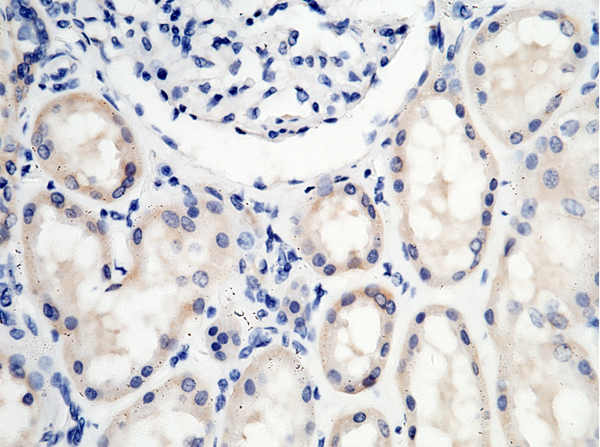
 IHC (Immunohiostchemistry)
(Immunochemical staining of human INSR in human kidney with rabbit polyclonal antibody (1:60, formalin-fixed paraffin embedded sections).)
IHC (Immunohiostchemistry)
(Immunochemical staining of human INSR in human kidney with rabbit polyclonal antibody (1:60, formalin-fixed paraffin embedded sections).)
Rabbit anti-Human Insulin Receptor Polyclonal Antibody | anti-INSR antibody
Anti-Insulin Receptor Antibody, Rabbit Polyclonal
Gene Names
INSR; HHF5; CD220
Reactivity
Human
Applications
Immunohistochemistry, ELISA
Purity
Protein A & Antigen Affinity
Synonyms
Insulin Receptor, Antibody; Anti-Insulin Receptor Antibody, Rabbit Polyclonal; Insulin Receptor/CD220/INSR Antibody, Rabbit PAb, Antigen Affinity Purified; insulin receptor; Anti-CD220 Antibody; Anti-HHF5 Antibody; Anti-Insulin Receptor Antibody; anti-INSR antibody
Host
Rabbit
Reactivity
Human
Clonality
Polyclonal
Isotype
Rabbit IgG
Specificity
Human Insulin Receptor/CD220/INSR
Purity/Purification
Protein A & Antigen Affinity
Form/Format
Liquid; 0.2um filtered solution in PBS
Applicable Applications for anti-INSR antibody
IHC (Immunohistochemistry), ELISA
Immunogen
Recombinant Human Insulin Receptor/CD220/INSR protein
Conjugation
Unconjugated
Preparation
Produced in rabbits immunized with purified, recombinant Human Insulin Receptor/CD220/INSR (rh Insulin Receptor/CD220/INSR). Insulin Receptor/CD220/INSR specific IgG was purified by Human Insulin Receptor/CD220/INSR affinity chromatography.
Preparation and Storage
This antibody can be stored at 2-8 degree C for one month without detectable loss of activity. Antibody products are stable for twelve months from date of receipt when stored at -20 degree C to -80 degree C. Preservative-Free. Avoid repeated freeze-thaw cycles.
IHC (Immunohiostchemistry)
(Immunochemical staining of human INSR in human kidney with rabbit polyclonal antibody (1:60, formalin-fixed paraffin embedded sections).)
IHC (Immunohiostchemistry)
(Immunochemical staining of human INSR in human kidney with rabbit polyclonal antibody (1:60, formalin-fixed paraffin embedded sections).)
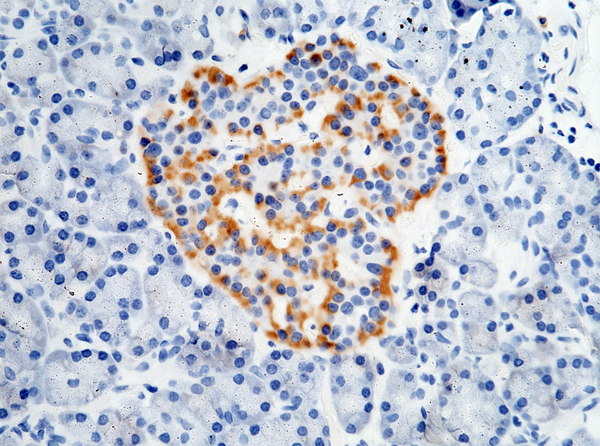
IHC (Immunohistochemistry)
(Immunochemical staining of human INSR in human pancreas with rabbit polyclonal antibody (1:60, formalin-fixed paraffin embedded sections).)
IHC (Immunohistochemistry)
(Immunochemical staining of human INSR in human pancreas with rabbit polyclonal antibody (1:60, formalin-fixed paraffin embedded sections).)
Related Product Information for anti-INSR antibody
INSR (Insulin receptor), also known as CD22, is a transmembrane receptor that is activated by insulin. INSR belongs to the protein kinase superfamily and exists as a tetramer consisting of two alpha subunits and two beta subunits linked by disulfide bonds. The alpha and beta subunits are encoded by a single INSR gene, and the beta subunits pass through the cellular membrane. As the receptor for insulin with tyrosine-protein kinase activity, INSR associates with downstream mediators upon binding to insulin, including IRS1 (insulin receptor substrate 1) and phosphatidylinositol 3'-kinase (PI3K). IRS-1 binding and phosphorylation eventually lead to an increase in the high-affinity glucose transporter (Glut4) molecules on the outer membrane of insulin-responsive tissues. INSR isoform long and isoform short are expressed in the peripheral nerve, kidney, liver, striated muscle, fibroblasts and skin, and is found as a hybrid receptor with IGF1R which also binds IGF1 in muscle, heart, kidney, adipose tissue, skeletal muscle, hepatoma, fibroblasts, spleen, and placenta. Defects in Insulin Receptor/INSR are the cause of Rabson-Mendenhall syndrome (Mendenhall syndrome), insulin resistance (Ins resistance), leprechaunism (Donohue syndrome), and familial hyperinsulinemic hypoglycemia 5 (HHF5). It may also be associated with noninsulin-dependent diabetes mellitus (NIDDM).
Product Categories/Family for anti-INSR antibody
References
Ebina Y., et al., (1985), The human insulin receptor cDNA: the structural basis for hormone-activated transmembrane signalling. Cell 40:747-758.Ullrich A., et al., (1985), Human insulin receptor and its relationship to the tyrosine kinase family of oncogenes.Nature 313:756-761.Grimwood J., et al., (2004), The DNA sequence and biology of human chromosome 19.Nature 428:529-535.
NCBI and Uniprot Product Information
NCBI GI #
NCBI GeneID
NCBI Accession #
NCBI GenBank Nucleotide #
Molecular Weight
156,333 Da
NCBI Official Full Name
insulin receptor isoform Long preproprotein
NCBI Official Synonym Full Names
insulin receptor
NCBI Official Symbol
INSR
NCBI Official Synonym Symbols
HHF5; CD220
NCBI Protein Information
insulin receptor; IR
UniProt Protein Name
Insulin receptor
UniProt Gene Name
INSR
UniProt Synonym Gene Names
IR
UniProt Entry Name
INSR_HUMAN
Customer Reviews
Loading reviews...
Share Your Experience
Similar Products






Product Notes
The INSR insr (Catalog #AAA255315) is an Antibody produced from Rabbit and is intended for research purposes only. The product is available for immediate purchase. The Anti-Insulin Receptor Antibody, Rabbit Polyclonal reacts with Human and may cross-react with other species as described in the data sheet. AAA Biotech's Insulin Receptor can be used in a range of immunoassay formats including, but not limited to, IHC (Immunohistochemistry), ELISA. Researchers should empirically determine the suitability of the INSR insr for an application not listed in the data sheet. Researchers commonly develop new applications and it is an integral, important part of the investigative research process. It is sometimes possible for the material contained within the vial of "Insulin Receptor, Polyclonal Antibody" to become dispersed throughout the inside of the vial, particularly around the seal of said vial, during shipment and storage. We always suggest centrifuging these vials to consolidate all of the liquid away from the lid and to the bottom of the vial prior to opening. Please be advised that certain products may require dry ice for shipping and that, if this is the case, an additional dry ice fee may also be required.Precautions
All products in the AAA Biotech catalog are strictly for research-use only, and are absolutely not suitable for use in any sort of medical, therapeutic, prophylactic, in-vivo, or diagnostic capacity. By purchasing a product from AAA Biotech, you are explicitly certifying that said products will be properly tested and used in line with industry standard. AAA Biotech and its authorized distribution partners reserve the right to refuse to fulfill any order if we have any indication that a purchaser may be intending to use a product outside of our accepted criteria.Disclaimer
Though we do strive to guarantee the information represented in this datasheet, AAA Biotech cannot be held responsible for any oversights or imprecisions. AAA Biotech reserves the right to adjust any aspect of this datasheet at any time and without notice. It is the responsibility of the customer to inform AAA Biotech of any product performance issues observed or experienced within 30 days of receipt of said product. To see additional details on this or any of our other policies, please see our Terms & Conditions page.Item has been added to Shopping Cart
If you are ready to order, navigate to Shopping Cart and get ready to checkout.