
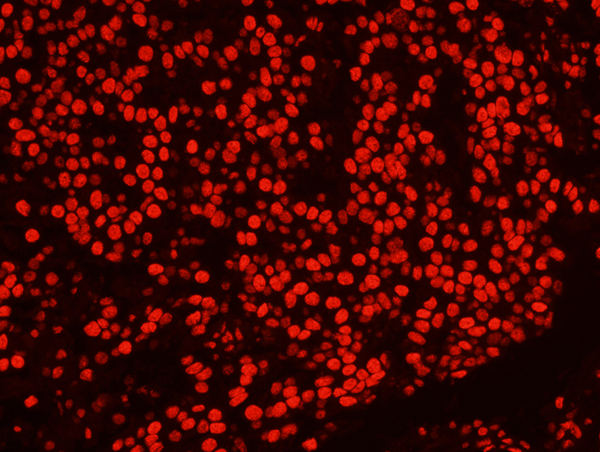
 IHC (Immunohistochemisry)
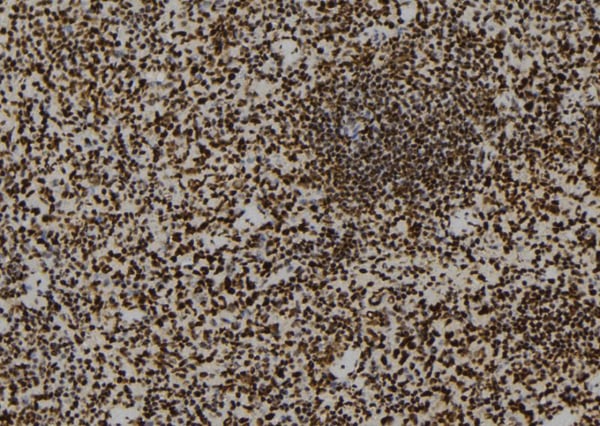
(AAA323141 at 1/100 staining Mouse spleen tissue by IHC-P. The sample was formaldehyde fixed and a heat mediated antigen retrieval step in citrate buffer was performed. The sample was then blocked and incubated with the antibody for 1.5 hours at 22 degree C. An HRP conjugated goat anti-rabbit antibody was used as the secondary.)
IHC (Immunohistochemisry)
(AAA323141 at 1/100 staining Mouse spleen tissue by IHC-P. The sample was formaldehyde fixed and a heat mediated antigen retrieval step in citrate buffer was performed. The sample was then blocked and incubated with the antibody for 1.5 hours at 22 degree C. An HRP conjugated goat anti-rabbit antibody was used as the secondary.)
Rabbit SFPQ Polyclonal Antibody | anti-SFPQ antibody
SFPQ Antibody
Gene Names
SFPQ; PSF; POMP100; PPP1R140
Reactivity
Human, Mouse, Rat
Applications
Immunohistochemistry, Western Blot
Purity
The antiserum was purified by peptide affinity chromatography using SulfoLink Coupling Resin.
Synonyms
SFPQ, Antibody; SFPQ Antibody; 100 kDa DNA pairing protein; 100 kDa DNA-pairing protein; 100 kDa subunit; DNA binding p52/p100 complex 100 kDa subunit; DNA-binding p52/p100 complex; hPOMp100; Polypyrimidine tract binding protein associated splicing factor; Polypyrimidine tract-binding protein-associated-splicing factor; POMP100; PPP1R140; proline-and glutamine-rich; Protein phosphatase 1 regulatory subunit 140; PSF; PTB associated splicing factor; PTB-associated-splicing factor; Sfpq; SFPQ_HUMAN; Splicing factor; Splicing factor proline and glutamine rich; Splicing factor proline/glutamine rich (polypyrimidine tract binding protein associated); Splicing factor proline/glutamine rich; anti-SFPQ antibody
Host
Rabbit
Reactivity
Human, Mouse, Rat
Clonality
Polyclonal
Isotype
IgG
Specificity
SFPQ antibody detects endogenous levels of SFPQ.
Purity/Purification
The antiserum was purified by peptide affinity chromatography using SulfoLink Coupling Resin.
Form/Format
Liquid
Phosphate buffered saline, pH 7.4, 150mM NaCl, 0.02% sodium azide and 50% glycerol.
Phosphate buffered saline, pH 7.4, 150mM NaCl, 0.02% sodium azide and 50% glycerol.
Concentration
1mg/ml (varies by lot)
Sequence Length
707
Applicable Applications for anti-SFPQ antibody
IHC (Immunohistochemistry), WB (Western Blot)
Immunogen
A synthesized peptide derived from human SFPQ.
Subcellular Location
Nucleus Matrix. Predominantly in nuclear matrix.
Predicted Cross Reactivity
Pig, Bovine, Horse, Sheep, Rabbit
Similarity
Pig (100%), Bovine (100%), Horse (100%), Sheep (100%), Rabbit (100%)
Conjugation
Unconjugated
Preparation and Storage
Store at -20 degree C. Stable for 12 months from date of receipt.
IHC (Immunohistochemisry)
(AAA323141 at 1/100 staining Mouse spleen tissue by IHC-P. The sample was formaldehyde fixed and a heat mediated antigen retrieval step in citrate buffer was performed. The sample was then blocked and incubated with the antibody for 1.5 hours at 22 degree C. An HRP conjugated goat anti-rabbit antibody was used as the secondary.)
IHC (Immunohistochemisry)
(AAA323141 at 1/100 staining Mouse spleen tissue by IHC-P. The sample was formaldehyde fixed and a heat mediated antigen retrieval step in citrate buffer was performed. The sample was then blocked and incubated with the antibody for 1.5 hours at 22 degree C. An HRP conjugated goat anti-rabbit antibody was used as the secondary.)
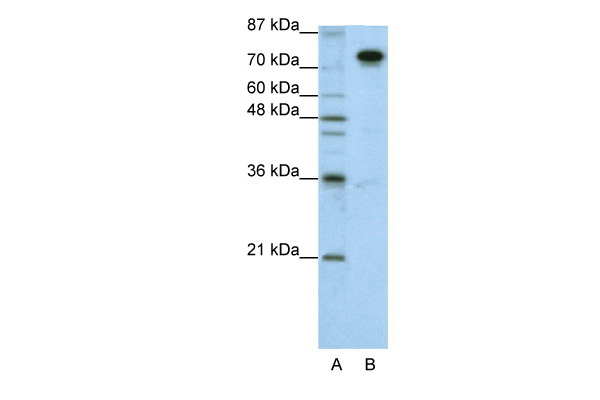
WB (Western Blot)
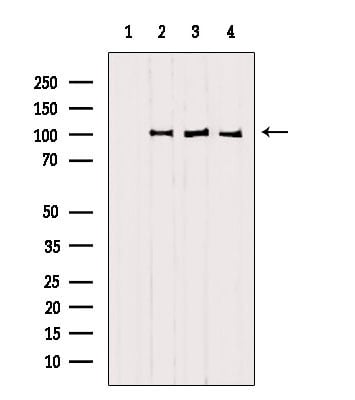
(Western blot analysis of extracts from various samples, using SFPQ antibody. Lane 1: mouse brain treated with blocking peptide. Lane 2: Mouse brain; Lane 3: 3T3; Lane 4: Hela;)
WB (Western Blot)
(Western blot analysis of extracts from various samples, using SFPQ antibody. Lane 1: mouse brain treated with blocking peptide. Lane 2: Mouse brain; Lane 3: 3T3; Lane 4: Hela;)
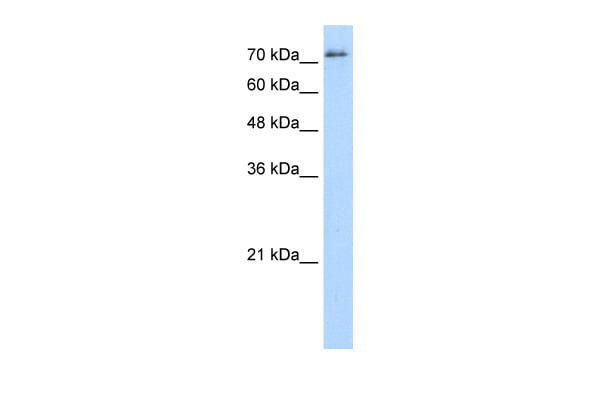
WB (Western Blot)
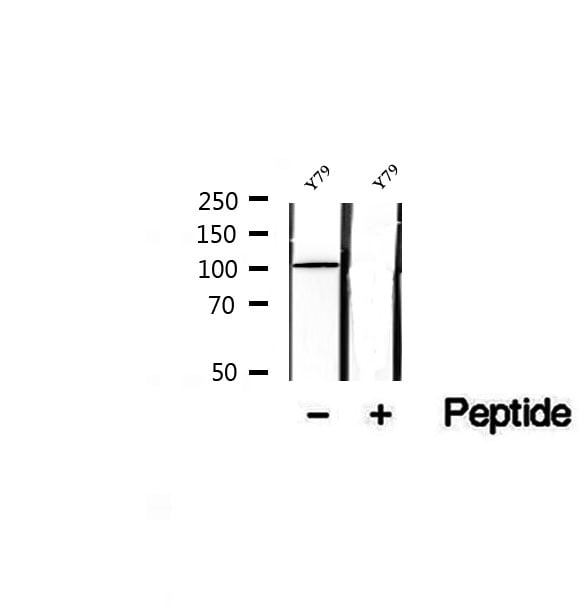
(Western blot analysis of extracts of Y79 cells, using SFPQ antibody.)
WB (Western Blot)
(Western blot analysis of extracts of Y79 cells, using SFPQ antibody.)
Related Product Information for anti-SFPQ antibody
Function: DNA-and RNA binding protein, involved in several nuclear processes. Essential pre-mRNA splicing factor required early in spliceosome formation and for splicing catalytic step II, probably as a heteromer with NONO. Binds to pre-mRNA in spliceosome C complex, and specifically binds to intronic polypyrimidine tracts. Involved in regulation of signal-induced alternative splicing. During splicing of PTPRC/CD45, a phosphorylated form is sequestered by THRAP3 from the pre-mRNA in resting T-cells; T-cell activation and subsequent reduced phosphorylation is proposed to lead to release from THRAP3 allowing binding to pre-mRNA splicing regulatotry elements which represses exon inclusion. Interacts with U5 snRNA, probably by binding to a purine-rich sequence located on the 3' side of U5 snRNA stem 1b. May be involved in a pre-mRNA coupled splicing and polyadenylation process as component of a snRNP-free complex with SNRPA/U1A. The SFPQ-NONO heteromer associated with MATR3 may play a role in nuclear retention of defective RNAs. SFPQ may be involved in homologous DNA pairing; in vitro, promotes the invasion of ssDNA between a duplex DNA and produces a D-loop formation. The SFPQ-NONO heteromer may be involved in DNA unwinding by modulating the function of topoisomerase I/TOP1; in vitro, stimulates dissociation of TOP1 from DNA after cleavage and enhances its jumping between separate DNA helices. The SFPQ-NONO heteromer binds DNA (PubMed:25765647). The SFPQ-NONO heteromer may be involved in DNA non-homologous end joining (NHEJ) required for double-strand break repair and V(D)J recombination and may stabilize paired DNA ends; in vitro, the complex strongly stimulates DNA end joining, binds directly to the DNA substrates and cooperates with the Ku70/G22P1-Ku80/XRCC5 (Ku) dimer to establish a functional preligation complex. SFPQ is involved in transcriptional regulation. Functions as transcriptional activator (PubMed:25765647). Transcriptional repression is mediated by an interaction of SFPQ with SIN3A and subsequent recruitment of histone deacetylases (HDACs). The SFPQ-NONO-NR5A1 complex binds to the CYP17 promoter and regulates basal and cAMP-dependent transcriptional activity. SFPQ isoform Long binds to the DNA binding domains (DBD) of nuclear hormone receptors, like RXRA and probably THRA, and acts as transcriptional corepressor in absence of hormone ligands. Binds the DNA sequence 5'-CTGAGTC-3' in the insulin-like growth factor response element (IGFRE) and inhibits IGF-I-stimulated transcriptional activity. Regulates the circadian clock by repressing the transcriptional activator activity of the CLOCK-ARNTL/BMAL1 heterodimer. Required for the transcriptional repression of circadian target genes, such as PER1, mediated by the large PER complex through histone deacetylation (By similarity). Required for the assembly of nuclear speckles (PubMed:25765647). Plays a role in the regulation of DNA virus-mediated innate immune response by assembling into the HDP-RNP complex, a complex that serves as a platform for IRF3 phosphorylation and subsequent innate immune response activation through the cGAS-STING pathway (PubMed:28712728).
Subunit Structure: Heterodimer with NONO (PubMed:25765647). Monomer and component of the SFPQ-NONO complex, which is probably a heterotetramer of two 52 kDa (NONO) and two 100 kDa (SFPQ) subunits (PubMed:8439294, PubMed:25765647). The coiled coil domain mediates interaction with NONO, and can also mediate formation of long, linear homooligomers (in vitro) (PubMed:25765647). SFPQ is a component of spliceosome and U5.4/6 snRNP complexes (PubMed:9409622, PubMed:8045264, PubMed:12403470). Interacts with SNRPA/U1A (PubMed:9848648). Component of a snRNP-free complex with SNRPA/U1A (PubMed:9848648). Part of complex consisting of SFPQ, NONO and MATR3 (PubMed:11525732). Interacts with polypyrimidine tract-binding protein 1/PTB (PubMed:10653975). Part of a complex consisting of SFPQ, NONO and NR5A1 (PubMed:11897684). Interacts with RXRA, probably THRA, and SIN3A (PubMed:11259580). Interacts with TOP1 (PubMed:9756848). Part of a complex consisting of SFPQ, NONO and TOP1 (PubMed:9756848). Interacts with SNRNP70 in apoptotic cells (PubMed:11514619). Interacts with PSPC1. Interacts with RNF43 (PubMed:18655028). Interacts with PITX3 and NR4A2/NURR1 (By similarity). Interacts with PTK6 (PubMed:19439179). Interacts with THRAP3; the interaction is dependent on SFPQ phosphorylation at 'Thr-687' and inhibits binding of SFPQ to a ESS1 exonic splicing silencer element-containing RNA (PubMed:20932480). The large PER complex involved in the histone deacetylation is composed of at least HDAC1, PER2, SFPQ and SIN3A. Interacts with PER1 and PER2 (By similarity). Interacts with PQBP1 (PubMed:21933836).
Post-translational Modifications: The N-terminus is blocked. Phosphorylated on multiple serine and threonine residues during apoptosis. In vitro phosphorylated by PKC. Phosphorylation stimulates binding to DNA and D-loop formation, but inhibits binding to RNA. Phosphorylation of C-terminal tyrosines promotes its cytoplasmic localization, impaired its binding to polypyrimidine RNA and led to cell cycle arrest. In resting T-cells is phosphorylated at Thr-687 by GSK3B which is proposed to promote association with THRAP and to prevent binding to PTPRC/CD45 pre-mRNA; T-cell activation leads to reduced phosphorylation at Thr-687.
Similarity: The coiled coil domain mediates interaction with NONO, and can also mediate formation of long, linear homooligomers (in vitro). The coiled coil domain is required for optimal DNA binding, and optimal transcription activation.
Subunit Structure: Heterodimer with NONO (PubMed:25765647). Monomer and component of the SFPQ-NONO complex, which is probably a heterotetramer of two 52 kDa (NONO) and two 100 kDa (SFPQ) subunits (PubMed:8439294, PubMed:25765647). The coiled coil domain mediates interaction with NONO, and can also mediate formation of long, linear homooligomers (in vitro) (PubMed:25765647). SFPQ is a component of spliceosome and U5.4/6 snRNP complexes (PubMed:9409622, PubMed:8045264, PubMed:12403470). Interacts with SNRPA/U1A (PubMed:9848648). Component of a snRNP-free complex with SNRPA/U1A (PubMed:9848648). Part of complex consisting of SFPQ, NONO and MATR3 (PubMed:11525732). Interacts with polypyrimidine tract-binding protein 1/PTB (PubMed:10653975). Part of a complex consisting of SFPQ, NONO and NR5A1 (PubMed:11897684). Interacts with RXRA, probably THRA, and SIN3A (PubMed:11259580). Interacts with TOP1 (PubMed:9756848). Part of a complex consisting of SFPQ, NONO and TOP1 (PubMed:9756848). Interacts with SNRNP70 in apoptotic cells (PubMed:11514619). Interacts with PSPC1. Interacts with RNF43 (PubMed:18655028). Interacts with PITX3 and NR4A2/NURR1 (By similarity). Interacts with PTK6 (PubMed:19439179). Interacts with THRAP3; the interaction is dependent on SFPQ phosphorylation at 'Thr-687' and inhibits binding of SFPQ to a ESS1 exonic splicing silencer element-containing RNA (PubMed:20932480). The large PER complex involved in the histone deacetylation is composed of at least HDAC1, PER2, SFPQ and SIN3A. Interacts with PER1 and PER2 (By similarity). Interacts with PQBP1 (PubMed:21933836).
Post-translational Modifications: The N-terminus is blocked. Phosphorylated on multiple serine and threonine residues during apoptosis. In vitro phosphorylated by PKC. Phosphorylation stimulates binding to DNA and D-loop formation, but inhibits binding to RNA. Phosphorylation of C-terminal tyrosines promotes its cytoplasmic localization, impaired its binding to polypyrimidine RNA and led to cell cycle arrest. In resting T-cells is phosphorylated at Thr-687 by GSK3B which is proposed to promote association with THRAP and to prevent binding to PTPRC/CD45 pre-mRNA; T-cell activation leads to reduced phosphorylation at Thr-687.
Similarity: The coiled coil domain mediates interaction with NONO, and can also mediate formation of long, linear homooligomers (in vitro). The coiled coil domain is required for optimal DNA binding, and optimal transcription activation.
NCBI and Uniprot Product Information
NCBI GI #
NCBI GeneID
NCBI Accession #
NCBI GenBank Nucleotide #
Molecular Weight
Observed: 100 kDa
Predicted: 77 kDa
Predicted: 77 kDa
NCBI Official Full Name
splicing factor, proline- and glutamine-rich
NCBI Official Synonym Full Names
splicing factor proline and glutamine rich
NCBI Official Symbol
SFPQ
NCBI Official Synonym Symbols
PSF; POMP100; PPP1R140
NCBI Protein Information
splicing factor, proline- and glutamine-rich
UniProt Protein Name
Splicing factor, proline- and glutamine-rich
UniProt Gene Name
SFPQ
UniProt Synonym Gene Names
PSF; PSF1 PublicationManual assertion based on opinion iniRef.1; PTB-associated-splicing factor
Customer Reviews
Loading reviews...
Share Your Experience
Similar Products


Product Notes
The SFPQ sfpq (Catalog #AAA323141) is an Antibody produced from Rabbit and is intended for research purposes only. The product is available for immediate purchase. The SFPQ Antibody reacts with Human, Mouse, Rat and may cross-react with other species as described in the data sheet. AAA Biotech's SFPQ can be used in a range of immunoassay formats including, but not limited to, IHC (Immunohistochemistry), WB (Western Blot). Researchers should empirically determine the suitability of the SFPQ sfpq for an application not listed in the data sheet. Researchers commonly develop new applications and it is an integral, important part of the investigative research process. It is sometimes possible for the material contained within the vial of "SFPQ, Polyclonal Antibody" to become dispersed throughout the inside of the vial, particularly around the seal of said vial, during shipment and storage. We always suggest centrifuging these vials to consolidate all of the liquid away from the lid and to the bottom of the vial prior to opening. Please be advised that certain products may require dry ice for shipping and that, if this is the case, an additional dry ice fee may also be required.Precautions
All products in the AAA Biotech catalog are strictly for research-use only, and are absolutely not suitable for use in any sort of medical, therapeutic, prophylactic, in-vivo, or diagnostic capacity. By purchasing a product from AAA Biotech, you are explicitly certifying that said products will be properly tested and used in line with industry standard. AAA Biotech and its authorized distribution partners reserve the right to refuse to fulfill any order if we have any indication that a purchaser may be intending to use a product outside of our accepted criteria.Disclaimer
Though we do strive to guarantee the information represented in this datasheet, AAA Biotech cannot be held responsible for any oversights or imprecisions. AAA Biotech reserves the right to adjust any aspect of this datasheet at any time and without notice. It is the responsibility of the customer to inform AAA Biotech of any product performance issues observed or experienced within 30 days of receipt of said product. To see additional details on this or any of our other policies, please see our Terms & Conditions page.Item has been added to Shopping Cart
If you are ready to order, navigate to Shopping Cart and get ready to checkout.