


 IF (Immunofluorescence)
(Immunofluorescence staining of Raw264.7 cells with AAA27029 at 1:100, counter-stained with DAPI. The cells were blocked in 10% normal Goat Serum and then incubated with the primary antibody overnight at 4 degree C. The secondary antibody was Alexa Fluor 488-congugated AffiniPure Goat Anti-Mouse IgG(H+L).)
IF (Immunofluorescence)
(Immunofluorescence staining of Raw264.7 cells with AAA27029 at 1:100, counter-stained with DAPI. The cells were blocked in 10% normal Goat Serum and then incubated with the primary antibody overnight at 4 degree C. The secondary antibody was Alexa Fluor 488-congugated AffiniPure Goat Anti-Mouse IgG(H+L).)
Mouse CD14 Monoclonal Antibody | anti-CD14 antibody
CD14 Monoclonal Antibody
Preservative: 0.03% Proclin 300
Constituents: 50% Glycerol, 0.01M PBS, pH 7.4
IHC: 1:50-1:200
IF: 1:50-1:200
IF (Immunofluorescence)
(Immunofluorescence staining of Raw264.7 cells with AAA27029 at 1:100, counter-stained with DAPI. The cells were blocked in 10% normal Goat Serum and then incubated with the primary antibody overnight at 4 degree C. The secondary antibody was Alexa Fluor 488-congugated AffiniPure Goat Anti-Mouse IgG(H+L).)
IF (Immunofluorescence)
(Immunofluorescence staining of Raw264.7 cells with AAA27029 at 1:100, counter-stained with DAPI. The cells were blocked in 10% normal Goat Serum and then incubated with the primary antibody overnight at 4 degree C. The secondary antibody was Alexa Fluor 488-congugated AffiniPure Goat Anti-Mouse IgG(H+L).)
IF (Immunofluorescence)
(Immunofluorescence staining of HepG2 cells with AAA27029 at 1:100, counter-stained with DAPI. The cells were blocked in 10% normal Goat Serum and then incubated with the primary antibody overnight at 4 degree C. The secondary antibody was Alexa Fluor 488-congugated AffiniPure Goat Anti-Mouse IgG(H+L).)
IF (Immunofluorescence)
(Immunofluorescence staining of HepG2 cells with AAA27029 at 1:100, counter-stained with DAPI. The cells were blocked in 10% normal Goat Serum and then incubated with the primary antibody overnight at 4 degree C. The secondary antibody was Alexa Fluor 488-congugated AffiniPure Goat Anti-Mouse IgG(H+L).)
IF (Immunofluorescence)
(Immunofluorescence staining of A549 cells with AAA27029 at 1:100, counter-stained with DAPI. The cells were blocked in 10% normal Goat Serum and then incubated with the primary antibody overnight at 4 degree C. The secondary antibody was Alexa Fluor 488-congugated AffiniPure Goat Anti-Mouse IgG(H+L).)
IF (Immunofluorescence)
(Immunofluorescence staining of A549 cells with AAA27029 at 1:100, counter-stained with DAPI. The cells were blocked in 10% normal Goat Serum and then incubated with the primary antibody overnight at 4 degree C. The secondary antibody was Alexa Fluor 488-congugated AffiniPure Goat Anti-Mouse IgG(H+L).)
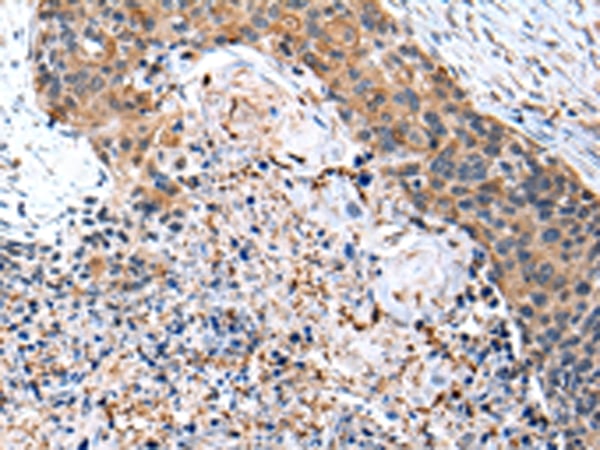
IHC (Immunohistochemistry)
(IHC image of AAA27029 diluted at 1:100 and staining in paraffin-embedded human breast cancer performed on a Leica BondTM system. After dewaxing and hydration, antigen retrieval was mediated by high pressure in a citrate buffer (pH 6.0). Section was blocked with 10% normal goat serum 30min at RT. Then primary antibody (1% BSA) was incubated at 4 degree C overnight. The primary is detected by a biotinylated secondary antibody and visualized using an HRP conjugated SP system.)
IHC (Immunohistochemistry)
(IHC image of AAA27029 diluted at 1:100 and staining in paraffin-embedded human breast cancer performed on a Leica BondTM system. After dewaxing and hydration, antigen retrieval was mediated by high pressure in a citrate buffer (pH 6.0). Section was blocked with 10% normal goat serum 30min at RT. Then primary antibody (1% BSA) was incubated at 4 degree C overnight. The primary is detected by a biotinylated secondary antibody and visualized using an HRP conjugated SP system.)
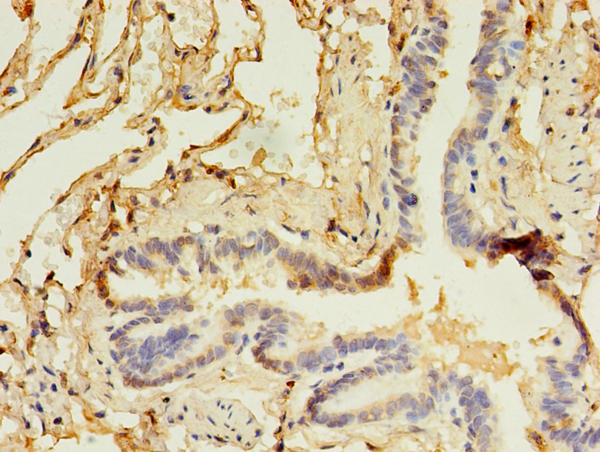
IHC (Immunohistchemistry)
(IHC image of AAA27029 diluted at 1:100 and staining in paraffin-embedded human lung cancer performed on a Leica BondTM system. After dewaxing and hydration, antigen retrieval was mediated by high pressure in a citrate buffer (pH 6.0). Section was blocked with 10% normal goat serum 30min at RT. Then primary antibody (1% BSA) was incubated at 4 degree C overnight. The primary is detected by a biotinylated secondary antibody and visualized using an HRP conjugated SP system.)
IHC (Immunohistchemistry)
(IHC image of AAA27029 diluted at 1:100 and staining in paraffin-embedded human lung cancer performed on a Leica BondTM system. After dewaxing and hydration, antigen retrieval was mediated by high pressure in a citrate buffer (pH 6.0). Section was blocked with 10% normal goat serum 30min at RT. Then primary antibody (1% BSA) was incubated at 4 degree C overnight. The primary is detected by a biotinylated secondary antibody and visualized using an HRP conjugated SP system.)
IHC (Immunohistochemistry)
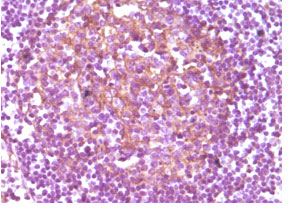
(IHC image of AAA27029 diluted at 1:100 and staining in paraffin-embedded human tonsil tissue performed on a Leica BondTM system. After dewaxing and hydration, antigen retrieval was mediated by high pressure in a citrate buffer (pH 6.0). Section was blocked with 10% normal goat serum 30min at RT. Then primary antibody (1% BSA) was incubated at 4 degree C overnight. The primary is detected by a biotinylated secondary antibody and visualized using an HRP conjugated SP system.)
IHC (Immunohistochemistry)
(IHC image of AAA27029 diluted at 1:100 and staining in paraffin-embedded human tonsil tissue performed on a Leica BondTM system. After dewaxing and hydration, antigen retrieval was mediated by high pressure in a citrate buffer (pH 6.0). Section was blocked with 10% normal goat serum 30min at RT. Then primary antibody (1% BSA) was incubated at 4 degree C overnight. The primary is detected by a biotinylated secondary antibody and visualized using an HRP conjugated SP system.)
WB (Western Blot)
(Western BlotPositive WB detected in: HepG2 whole cell lysate, A549 whole cell lysate, Hela whole cell lysate, Jurkat whole cell lysate, NIH/3T3 whole cell lysateAll lanes: CD14 antibody at 1:1000SecondaryGoat polyclonal to Mouse IgG at 1/10000 dilutionPredicted band size: 41 kDaObserved band size: 55 kDa)
WB (Western Blot)
(Western BlotPositive WB detected in: HepG2 whole cell lysate, A549 whole cell lysate, Hela whole cell lysate, Jurkat whole cell lysate, NIH/3T3 whole cell lysateAll lanes: CD14 antibody at 1:1000SecondaryGoat polyclonal to Mouse IgG at 1/10000 dilutionPredicted band size: 41 kDaObserved band size: 55 kDa)
WB (Western Blot)
(Western BlotPositive WB detected in: NIH/3T3 whole cell lysateAll lanes: CD14 antibody at at 1:1000, 1:2000, 1:4000, 1:8000, 1:16000, 1:32000, 1:64000SecondaryGoat polyclonal to Mouse IgG at 1/10000 dilutionPredicted band size: 41 kDaObserved band size: 55 kDa)
WB (Western Blot)
(Western BlotPositive WB detected in: NIH/3T3 whole cell lysateAll lanes: CD14 antibody at at 1:1000, 1:2000, 1:4000, 1:8000, 1:16000, 1:32000, 1:64000SecondaryGoat polyclonal to Mouse IgG at 1/10000 dilutionPredicted band size: 41 kDaObserved band size: 55 kDa)
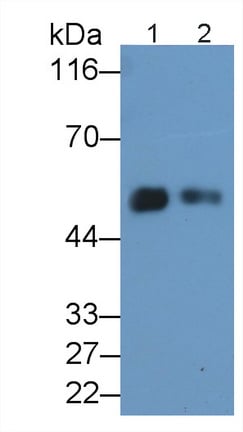
WB (Western Blot)
(Western BlotPositive WB detected in: Mouse kidney tissue, Rat liver tissueAll lanes: CD14 antibody at 1:2000SecondaryGoat polyclonal to Mouse IgG at 1/10000 dilutionPredicted band size: 41 kDaObserved band size: 55 kDa)
WB (Western Blot)
(Western BlotPositive WB detected in: Mouse kidney tissue, Rat liver tissueAll lanes: CD14 antibody at 1:2000SecondaryGoat polyclonal to Mouse IgG at 1/10000 dilutionPredicted band size: 41 kDaObserved band size: 55 kDa)
WB (Western Blot)
(Western BlotPositive WB detected in: Rabbit lung tissue, Rabbit liver tissue, Rabbit spleen tissue, Rabbit small intestine tissueAll lanes: CD14 antibody at 1:2500SecondaryGoat polyclonal to Mouse IgG at 1/10000 dilutionPredicted band size: 41 kDaObserved band size: 55 kDa)
WB (Western Blot)
(Western BlotPositive WB detected in: Rabbit lung tissue, Rabbit liver tissue, Rabbit spleen tissue, Rabbit small intestine tissueAll lanes: CD14 antibody at 1:2500SecondaryGoat polyclonal to Mouse IgG at 1/10000 dilutionPredicted band size: 41 kDaObserved band size: 55 kDa)
NCBI and Uniprot Product Information
Customer Reviews
Loading reviews...
Share Your Experience
Similar Products


Product Notes
The CD14 cd14 (Catalog #AAA27029) is an Antibody produced from Mouse and is intended for research purposes only. The product is available for immediate purchase. The CD14 Monoclonal Antibody reacts with Human, Mouse, Rat, Rabbit and may cross-react with other species as described in the data sheet. AAA Biotech's CD14 can be used in a range of immunoassay formats including, but not limited to, ELISA, WB (Western Blot), IHC (Immunohistochemistry), IF (Immunofluorescence). WB: 1:1000-1:64000 IHC: 1:50-1:200 IF: 1:50-1:200. Researchers should empirically determine the suitability of the CD14 cd14 for an application not listed in the data sheet. Researchers commonly develop new applications and it is an integral, important part of the investigative research process. It is sometimes possible for the material contained within the vial of "CD14, Monoclonal Antibody" to become dispersed throughout the inside of the vial, particularly around the seal of said vial, during shipment and storage. We always suggest centrifuging these vials to consolidate all of the liquid away from the lid and to the bottom of the vial prior to opening. Please be advised that certain products may require dry ice for shipping and that, if this is the case, an additional dry ice fee may also be required.Precautions
All products in the AAA Biotech catalog are strictly for research-use only, and are absolutely not suitable for use in any sort of medical, therapeutic, prophylactic, in-vivo, or diagnostic capacity. By purchasing a product from AAA Biotech, you are explicitly certifying that said products will be properly tested and used in line with industry standard. AAA Biotech and its authorized distribution partners reserve the right to refuse to fulfill any order if we have any indication that a purchaser may be intending to use a product outside of our accepted criteria.Disclaimer
Though we do strive to guarantee the information represented in this datasheet, AAA Biotech cannot be held responsible for any oversights or imprecisions. AAA Biotech reserves the right to adjust any aspect of this datasheet at any time and without notice. It is the responsibility of the customer to inform AAA Biotech of any product performance issues observed or experienced within 30 days of receipt of said product. To see additional details on this or any of our other policies, please see our Terms & Conditions page.Frequently Asked Questions
What cell types is CD14 commonly used as a marker for?
CD14 is the primary marker for monocytes and is also expressed on macrophages, dendritic cells, and a subset of neutrophils. CD14+ monocytes comprise approximately 10–15% of peripheral blood leukocytes and are further subdivided into classical, intermediate, and non-classical monocyte subsets based on CD14 expression levels and co-marker expression.
How many types of monoclonal antibodies are there?
Monoclonal antibodies exist in numerous types, classified by: isotype (IgG, IgM, IgA, IgE, IgD), subclass (IgG1, IgG2, IgG3, IgG4), source (mouse, human, humanized, chimeric), and conjugation (unconjugated, FITC, PE, APC, biotin, HRP). For CD14, both mouse and humanized versions are available in multiple fluorescent and enzymatic conjugates.
Which monoclonal antibody is used to detect CD20?
CD20 is detected by various monoclonal antibodies, including rituximab, atumumab, and research-grade clones (e.g., SP32, B-Ly1). Different CD20 antibodies show distinct properties: type I antibodies efficiently activate complement, while type II promote cellular adhesion and apoptosis, affecting their therapeutic mechanisms in B cell depletion.
What is the biological role of CD14 in the immune system?
CD14 is a co-receptor for lipopolysaccharide (LPS) recognition and TLR4 signaling in monocytes and macrophages, initiating pro-inflammatory responses to gram-negative bacteria. CD14 also facilitates phagocytosis, antigen presentation, and production of pro-inflammatory cytokines (IL-1β, IL-6, TNF-α) crucial for innate immune defense.
Is CD14 expressed on monocytes, macrophages, or both?
CD14 is expressed at high levels on classical monocytes in blood and macrophages in tissues. However, CD14 expression decreases during monocyte differentiation into macrophages and dendritic cells, with mature tissue macrophages and dendritic cells showing reduced or absent CD14 expression.
What is the difference between CD14 and other monocyte markers?
CD14 marks the monocyte lineage broadly, while other markers distinguish monocyte subsets: CD16 defines intermediate and non-classical monocytes, CD11b marks myeloid cells generally, and CCR2/CX3CR1 indicate functional monocyte migration patterns. CD14+CD16- identifies classical monocytes; CD14+CD16+ identifies intermediate monocytes.
Can CD14 monoclonal antibodies be used for flow cytometry?
Yes, CD14 monoclonal antibodies are extensively validated for flow cytometry to identify and quantify monocyte populations and subsets in blood, bone marrow, and tissue samples. Multiple fluorescent conjugates (FITC, PE, APC) are available, enabling multi-parameter immunophenotyping.
Does CD14 expression change during inflammation or infection?
Yes, CD14 expression increases transiently during acute bacterial infection and sepsis due to monocyte activation and release of soluble CD14 (sCD14) into circulation. In chronic inflammation, monocyte subset distributions shift, with increased intermediate and non-classical CD14+ monocytes associated with inflammatory disease states.
Is CD14 found on the cell surface or inside the cell?
CD14 is primarily a glycosylphosphatidylinositol (GPI)-anchored surface antigen expressed on the cell membrane of monocytes and macrophages, accessible to antibody binding. While CD14 is predominantly extracellular, a soluble form (sCD14) is shed from cell surfaces and circulates in blood as a marker of monocyte/macrophage activation.
Why is CD14 important in innate immune response studies?
CD14 is essential for bacterial lipopolysaccharide (LPS) recognition and initiation of TLR4-mediated innate immunity in monocytes. Studying CD14+ monocytes reveals monocyte responses to pathogens, pro-inflammatory cytokine production, antigen presentation capacity, and altered immune states in infection, sepsis, and chronic inflammation.
Item has been added to Shopping Cart
If you are ready to order, navigate to Shopping Cart and get ready to checkout.