
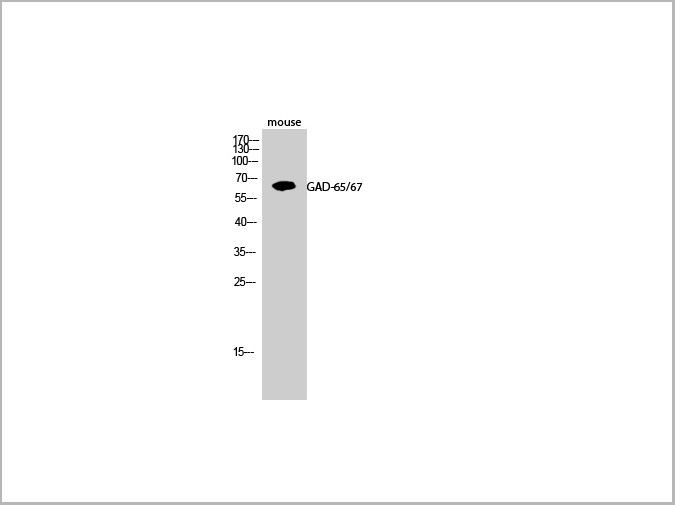
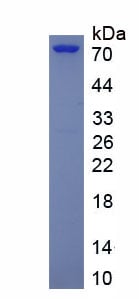
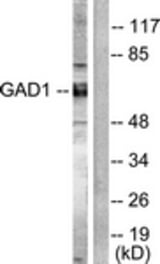
 WB (Western Blot)
(Western Blot analysis of Mouse cells with GAD-65/67 Polyclonal Antibody.)
WB (Western Blot)
(Western Blot analysis of Mouse cells with GAD-65/67 Polyclonal Antibody.)
Rabbit anti-Human, Mouse GAD-65/67 Polyclonal Antibody | anti-GAD-65/67 antibody
GAD-65/67 Polyclonal Antibody
IHC: 1:100-1:300
IF: 1:200-1:1000
ELISA: 1:5000
WB (Western Blot)
(Western Blot analysis of Mouse cells with GAD-65/67 Polyclonal Antibody.)
WB (Western Blot)
(Western Blot analysis of Mouse cells with GAD-65/67 Polyclonal Antibody.)
NCBI and Uniprot Product Information
Observed MW: 65 kDa
Customer Reviews
Loading reviews...
Share Your Experience
Similar Products



Product Notes
The GAD-65/67 (Catalog #AAA22057) is an Antibody produced from Rabbit and is intended for research purposes only. The product is available for immediate purchase. The GAD-65/67 Polyclonal Antibody reacts with Human, Mouse and may cross-react with other species as described in the data sheet. AAA Biotech's GAD-65/67 can be used in a range of immunoassay formats including, but not limited to, WB (Western Blot), IHC (Immunohistochemistry), IF (Immunofluorescence), ELISA. WB: 1:500-1:2000 IHC: 1:100-1:300 IF: 1:200-1:1000 ELISA: 1:5000. Researchers should empirically determine the suitability of the GAD-65/67 for an application not listed in the data sheet. Researchers commonly develop new applications and it is an integral, important part of the investigative research process. It is sometimes possible for the material contained within the vial of "GAD-65/67, Polyclonal Antibody" to become dispersed throughout the inside of the vial, particularly around the seal of said vial, during shipment and storage. We always suggest centrifuging these vials to consolidate all of the liquid away from the lid and to the bottom of the vial prior to opening. Please be advised that certain products may require dry ice for shipping and that, if this is the case, an additional dry ice fee may also be required.Precautions
All products in the AAA Biotech catalog are strictly for research-use only, and are absolutely not suitable for use in any sort of medical, therapeutic, prophylactic, in-vivo, or diagnostic capacity. By purchasing a product from AAA Biotech, you are explicitly certifying that said products will be properly tested and used in line with industry standard. AAA Biotech and its authorized distribution partners reserve the right to refuse to fulfill any order if we have any indication that a purchaser may be intending to use a product outside of our accepted criteria.Disclaimer
Though we do strive to guarantee the information represented in this datasheet, AAA Biotech cannot be held responsible for any oversights or imprecisions. AAA Biotech reserves the right to adjust any aspect of this datasheet at any time and without notice. It is the responsibility of the customer to inform AAA Biotech of any product performance issues observed or experienced within 30 days of receipt of said product. To see additional details on this or any of our other policies, please see our Terms & Conditions page.Frequently Asked Questions
What is GAD-65/67 in neuroscience research?
GAD-65 and GAD-67 are enzymes that help make GABA, an important chemical that helps calm the brain. In neuroscience research, they are studied to understand how nerve cells communicate and control brain activity.
Is GAD-65/67 a reliable marker for GABAergic neurons?
Yes, GAD-65/67 is a reliable marker for GABAergic neurons. These cells produce GABA (a calming brain chemical), and the proteins help produce it. Scientists detect these proteins to confirm GABA neurons.
What is the difference between GAD65 and GAD67 expression in the brain?
GAD67 is found throughout the neuron and helps with everyday GABA production. Whereas GAD65 is found near nerve endings and helps release GABA during active signaling. Studying both together gives a fuller picture of how inhibitory neurons work.
Can a GAD-65/67 antibody be used for immunofluorescence or IHC staining?
Yes, GAD-65/67 antibodies are used for immunofluorescence or IHC staining. These methods help researchers see where GAD-65/67 proteins are located in the brain or tissue samples under a microscope.
Is GAD-65/67 commonly studied in epilepsy, diabetes, or neurodegenerative diseases?
Yes, GAD-65/67 is commonly studied in epilepsy, diabetes, or neurodegenerative diseases. In epilepsy, it signals brain overactivity. In diabetes, GAD65 becomes an autoimmune target. In neurodegenerative diseases, GABA neuron changes reveal nerve damage.
Can this antibody detect GAD-65/67 in both central and peripheral nervous system tissues?
Yes, this antibody detects GAD-65/67 in both the central and peripheral nervous system tissues. GABAergic neurons exist in the brain, spinal cord, and some peripheral nerves, making it great for nervous system studies.
Can this GAD-65/67 antibody detect both human and mouse protein expression?
Yes, this polyclonal antibody specifically recognizes both human and mouse GAD65 (GAD2) and GAD67 (GAD1) with high cross-reactivity. GAD65 (585 amino acids, membrane-anchored) and GAD67 (594 amino acids) differ in cellular localization, but this preparation contains multiple epitope-specific antibodies detecting both isoforms reliably in human, mouse, and rat tissues.
Is GAD-65/67 a reliable marker for GABAergic neurons in brain tissue?
Yes, GAD65 and GAD67 are the most specific and reliable markers for GABAergic neurons. These glutamate decarboxylase isoforms catalyze the conversion of glutamic acid to GABA, the primary inhibitory neurotransmitter. GAD67 expression is constitutive in GABA neurons, while GAD65 is activity-dependent, enabling comprehensive GABAergic neuronal identification.
Can this antibody be used for immunofluorescence or immunohistochemistry applications?
Yes, this polyclonal is validated for both IF and IHC applications. It provides excellent nuclear and cytoplasmic contrast in fixed neurons, penetrates well in floating sections with strong signal-to-noise ratios, and works in FFPE sections with standard DAB or fluorescent detection protocols.
What is the difference between GAD65 and GAD67 detection with this antibody?
This polyclonal detects both GAD65 (65 kDa) and GAD67 (67 kDa) simultaneously. GAD67 is constitutively expressed in all GABAergic neurons, serving as a pan-marker for GABA-producing cells. GAD65 is differentially expressed based on neuronal activity and plasticity. The dual specificity allows assessment of both basal GABAergic identity and functional/adaptive status.
Does fixation method (PFA vs methanol) affect GAD-65/67 staining quality?
Yes, fixation significantly impacts staining quality. Paraformaldehyde (4%, 15-30 min at 4°C) preserves cellular morphology and epitope recognition without cross-linking artifacts. Methanol causes protein dehydration that can disrupt structural epitopes, potentially reducing signal specificity. We recommend 4% PFA with 15-30 minute fixation for optimal GAD-65/67 detection.
Is this antibody suitable for Western blot analysis of GAD-65/67?
Yes, this polyclonal is suitable for WB, detecting distinct bands at approximately 65 kDa (GAD65) and 67 kDa (GAD67). When separated by SDS-PAGE, both isoforms appear as distinct bands, allowing isoform-specific quantification. Use 0.5-2 μg/mL as the starting concentration; alternative splicing variants may produce additional bands depending on the tissue source.
Item has been added to Shopping Cart
If you are ready to order, navigate to Shopping Cart and get ready to checkout.