Antibody Validation Methods: KO, Knockdown & Orthogonal Approaches
 Cynthia
11 min read
Cynthia
11 min read
In this Article
- What Is Antibody Validation and Why Does It Matter?
- How Do You Choose Between Antibody Validation Methods?
- How Does Knockout Validation Confirm Antibody Specificity?
- What If a Knockout Cell Line Is Not Available?
- Knockdown Validation: When Gene Silencing Is More Practical
- Orthogonal Antibody Validation: Confirm the Target Independently
- What Are the 5 Pillars of Antibody Validation?
- How Should You Validate an Antibody for Different Applications?
- How Do You Know If Your Validation Evidence Is Strong Enough?
- What Should You Do When Validation Results Conflict?


All of the products listed in AAA Biotech’s catalog are strictly for research-use only (RUO).

Key Takeaways
- Antibody validation confirms that an antibody detects its intended target with the right specificity and performance for a given application.
- The IWGAV outlines five validation pillars: genetic, orthogonal, independent antibody, tagged protein, and immunocapture-mass spectrometry.
- Knockout removes the target gene completely, offering strong but not always practical evidence of specificity.
- Knockdown reduces target expression through RNA interference and works well when knockout is not feasible.
- Orthogonal validation compares antibody detection with antibody-independent methods, making it useful when no knockout model exists.
- Combining multiple approaches strengthens confidence, and conflicting results should prompt closer investigation rather than immediate rejection.
Does your antibody detect the intended protein, or just produce a convincing signal? What happens when a Western blot band remains after gene knockout? Can you trust an antibody in IHC simply because it worked in Western blot? These are important questions because antibody performance depends on the target, sample preparation, species, and application.
Antibody validation is therefore more than checking whether a datasheet says “validated.” The International Working Group for Antibody Validation (IWGAV) recommends application-specific testing and identifies five validation pillars: genetic, orthogonal, independent antibody, tagged protein expression, and immunocapture followed by mass spectrometry. At least one pillar should be used to support validation for a specific application, while combining methods can provide stronger evidence.
This guide focuses on three especially useful approaches: knockout, knockdown, and orthogonal validation, including when to use each and how to interpret conflicting results.
What Is Antibody Validation and Why Does It Matter?
Antibody validation is the process of confirming that an antibody detects its intended target with the right level of specificity and performance under specific experimental conditions.
A solid validation strategy should answer three key questions:
- Does the antibody bind to the intended target?
- Does it avoid significant off-target binding?
- Does it perform reliably in the application you plan to use it for?
Validation needs to be specific to both the application and the context. An antibody that performs well in Western blot may not perform the same way in IHC or flow cytometry, since sample preparation can alter protein structure and change the accessibility of the target epitope.
This is why a vendor's validation claim should not be taken at face value. Before using an antibody in your experiment, check the species tested, sample type, application, controls used, and the supporting data behind the claim.
How Do You Choose Between Antibody Validation Methods?
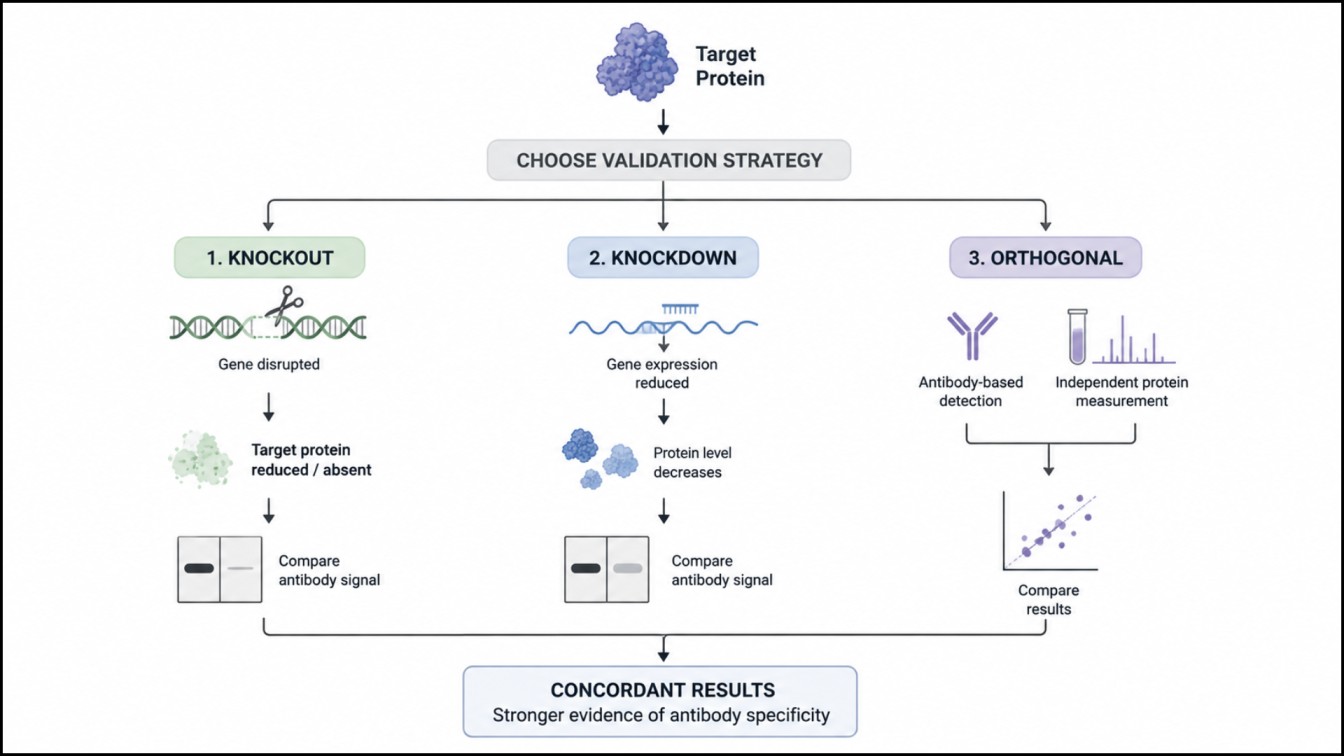
There is no single validation approach that works best for every antibody. The right choice depends on whether you can manipulate the target genetically, measure it independently, or compare recognition using another reagent.
| Experimental Situation | Useful Approach | Why It Works |
|---|---|---|
| Target can be genetically disrupted | Knockout | Removes the target completely, so any signal that remains points to off-target binding |
| Complete deletion is difficult | Knockdown | Lowers target levels, so a specific antibody should show a matching drop in signal |
| No knockout model is available | Orthogonal | Compares results from a method that does not rely on antibodies, such as mass spectrometry or RNA expression data |
| Two antibodies recognize different epitopes | Independent antibody | Agreement between antibodies targeting different regions builds confidence in specificity |
| Target can be expressed with a tag | Tagged protein | Confirms that the antibody detects the target using a marker that is independent of the antibody itself |
| Target needs direct identification | IP-MS | Identifies the bound protein directly, offering the most conclusive confirmation of target identity |
The right method also depends on practical limits:
- Knockdown rarely removes a target completely, so some background signal may remain even when the antibody is specific.
- Knockout offers a cleaner result but is not always possible for essential genes or in every cell type.
- Orthogonal validation offers a useful alternative in these cases, confirming the target through a method that does not depend on antibody binding.
The core principle stays the same across all methods: confirm a real connection between the antibody signal and the actual target, rather than relying on signal strength alone.
How Does Knockout Validation Confirm Antibody Specificity?
A knockout removes or disrupts the gene encoding the target protein. If an antibody is specific, its signal should decrease substantially or disappear in the knockout sample compared with the appropriate control.
A typical comparison involves:
Wild-type/control sample → target present → antibody signal expected
Knockout sample → target disrupted → target-dependent signal should decrease
This makes genetic validation particularly useful because the target itself is manipulated. IWGAV defines the genetic pillar as eliminating or significantly reducing target expression through genome editing or RNA interference.
However, a knockout result should not be interpreted in isolation. A remaining signal could have several explanations:
- The knockout is incomplete.
- The protein remains stable after gene disruption.
- The antibody recognizes an alternative isoform.
- A related protein shares the recognized epitope.
- The antibody has off-target binding.
- The experimental conditions differ between control and knockout samples.
Useful Tip: Confirm the genetic change independently and examine whether the expected protein-level change matches the antibody result.
This is also why knockout-validated antibodies should be considered in the context of the exact application tested. A KO-supported result in one assay does not automatically establish performance in every application.
What If a Knockout Cell Line Is Not Available?
A knockout model is useful, but it is not always practical. Some targets are essential for cell survival, a suitable knockout model may not exist, or developing one may take more time than the experiment allows.
In these cases, consider the following approaches:
- Knockdown: Reduce target expression and check for a matching drop in antibody signal.
- Orthogonal validation: Compare antibody-based detection with a method that does not rely on antibodies.
- Independent antibody testing: Use a second antibody that binds a different epitope on the same target.
- Tagged protein expression: Compare antibody detection with a tagged version of the target.
- IP-MS: Capture the target and confirm its identity using mass spectrometry.
Combining more than one of these methods strengthens the evidence for specificity. The IWGAV framework notes that while one validation pillar is the minimum standard, using multiple pillars provides stronger support for the conclusion.
Knockdown Validation: When Gene Silencing Is More Practical
Knockdown reduces target expression rather than eliminating the gene. RNA interference methods such as siRNA or shRNA offer a practical way to test whether antibody signal changes along with target abundance.
For a useful knockdown experiment, compare a proper control with the silenced condition and confirm that target levels were actually reduced before concluding.
A simple workflow looks like this:
- Silence the target gene.
- Confirm that target RNA levels have dropped.
- Assess target protein levels.
- Measure antibody signal.
- Compare the silenced condition with the control.
If RNA levels drop but antibody signal does not decrease, this does not automatically mean the antibody has failed. Protein turnover, incomplete silencing, protein isoforms, or technical variability could explain the result.
On the other hand, if both target protein levels and antibody signal decrease together, this supports antibody specificity, though confirming the result with another validation method is still good practice.
Knockout vs. Knockdown
| Factor | Knockout | Knockdown |
|---|---|---|
| Target reduction | Usually complete | Usually partial |
| Genetic change | Permanent or stable | Often temporary |
| Residual target | May still be present | Expected |
| Practicality | More demanding to set up | Often easier to perform |
| Main risk | Compensation or incomplete editing | Off-target effects or incomplete silencing |
Understanding this difference is essential when interpreting knockout-validated antibodies or antibodies supported by knockdown evidence.
Orthogonal Antibody Validation: Confirm the Target Independently
Orthogonal validation takes a different route. Instead of changing the target gene or using another antibody, it compares antibody-based detection with an antibody-independent method.
For example, target abundance can be measured using an independent analytical method and then compared with the antibody signal across samples with different levels of target protein.
If both measurements follow the same pattern, confidence in target specificity increases. This is the basis of orthogonal antibody validation. The IWGAV describes the orthogonal pillar as comparing target expression measured by the antibody with an antibody-independent method.
The important distinction is:
- Independent antibody validation: Two antibodies recognize different epitopes.
- Orthogonal validation: Antibody detection is compared with a method that does not depend on antibody recognition.
This makes orthogonal testing especially useful when a suitable knockout model is unavailable.
What Are the 5 Pillars of Antibody Validation?
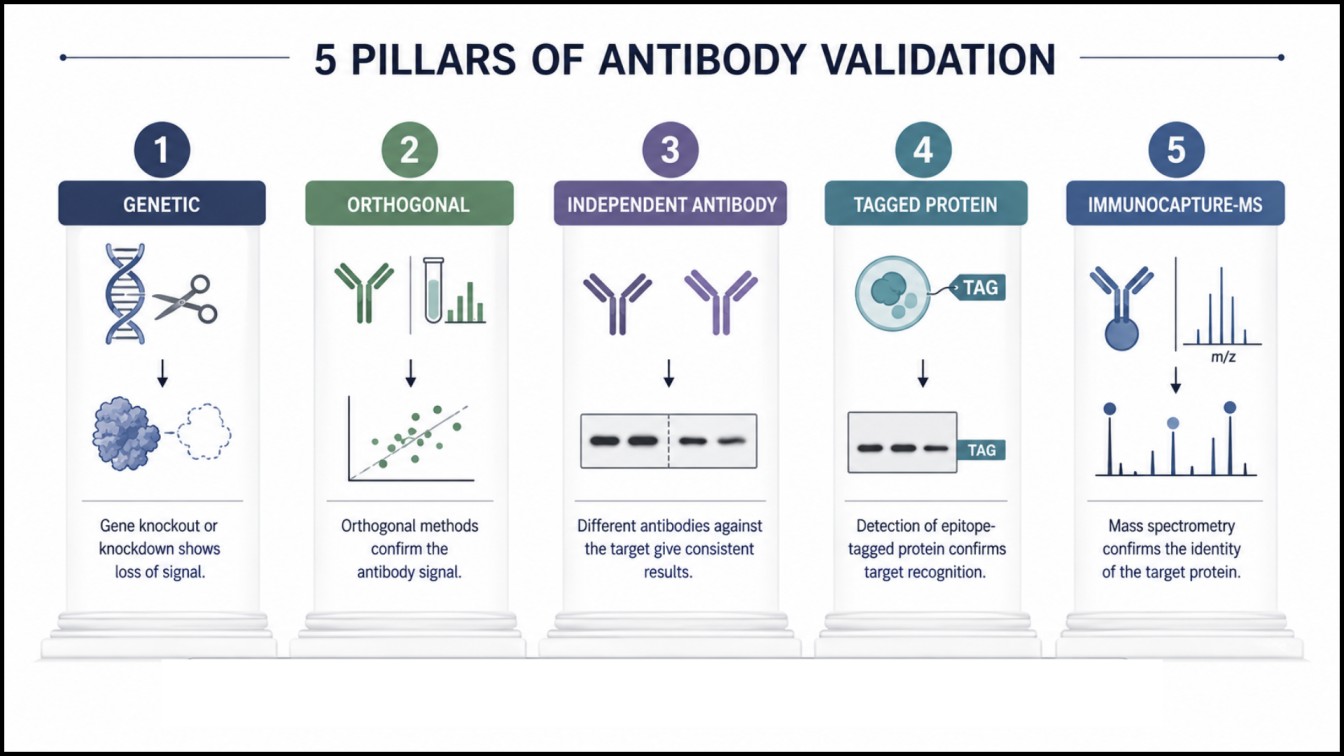
The International Working Group for Antibody Validation (IWGAV) proposed five pillars for application-specific antibody validation. This framework is widely cited in scientific journals and used by antibody vendors to support validation claims.
| Pillar | What It Tests |
|---|---|
| Genetic | Whether signal changes after the target is disrupted or reduced |
| Orthogonal | Whether signal agrees with an antibody-independent method |
| Independent antibody | Whether different antibodies recognize the same target |
| Tagged protein | Whether signal matches expression of a tagged version of the target |
| Immunocapture-MS | Whether the captured target is confirmed by mass spectrometry |
The IWGAV recommends using at least one pillar as the minimum standard for claiming adequate validation in a specific application. It also notes that combining multiple approaches provides stronger supporting evidence.
How Should You Validate an Antibody for Different Applications?
Validation should match the experiment you plan to perform. Sample preparation can alter protein structure and epitope accessibility, so evidence from one application should not automatically be transferred to another.
| Application | Key validation consideration |
|---|---|
| Western blot | Expected band size and target-dependent signal |
| IHC | Specific staining in the relevant tissue context |
| IF/ICC | Specific cellular localization |
| ELISA | Specific target binding and assay performance |
| Flow cytometry | Appropriate positive and negative populations |
| IP | Target enrichment and identity |
For example, an antibody that recognizes a denatured protein in Western blot may not recognize the same epitope after fixation. Likewise, an antibody can produce convincing staining while still binding unrelated proteins.
This application-specific approach is one of the most important principles in modern validation guidance.
How Do You Know If Your Validation Evidence Is Strong Enough?
Before relying on an antibody, work through a simple checklist:
- Correct target and species confirmed
- Intended application has supporting evidence
- Appropriate positive and negative controls included
- Target reduction or independent measurement confirmed
- Expected antibody signal observed
- Potential isoforms considered
- Results are reproducible
- Validation evidence is relevant to your sample type
An antibody validation worksheet can make this process easier by recording the antibody, target, application, sample type, controls, validation method, observed results, and limitations.
For larger projects, documenting these details before an antibody validation meeting can also help everyone agree on what evidence is required before experimental use.
Common Validation Mistakes That Can Mislead Results
Even a carefully designed experiment can lead to misleading conclusions if validation is interpreted too narrowly. Some of the most common mistakes include:
- Assuming one application proves all applications: Validation should be tied to the specific assay and sample conditions used.
- Treating a single band as proof of specificity: A band at the expected molecular weight does not, by itself, confirm that the antibody is specific.
- Not confirming knockdown efficiency: If gene silencing is weak, an unchanged antibody signal may simply reflect leftover target protein rather than antibody failure.
- Confusing orthogonal and independent-antibody approaches: A second antibody is not an orthogonal method. It is a separate antibody-based strategy and should not be treated as equivalent.
- Ignoring isoforms: Gene disruption may affect one form of a protein differently than another, depending on the model system and the antibody's target epitope.
- Relying only on a vendor's validation claim: Review the actual experimental evidence, including the application, species, controls, and validation strategy used.
What Should You Do When Validation Results Conflict?
Conflicting results do not necessarily mean the experiment has failed. They indicate that the evidence needs closer examination.
| Observation | Possible explanation | Next step |
|---|---|---|
| Signal remains after KO | Residual target or off-target binding | Confirm knockout and use another method |
| Signal falls after knockdown | Supports target dependence | Confirm silencing and protein reduction |
| RNA decreases but protein remains | Protein stability or incomplete effect | Measure protein independently |
| Antibody and independent assay disagree | Specificity or measurement issue | Review both methods |
| Two antibodies disagree | Different epitopes or specificity | Compare target regions and evidence |
The goal is not simply to make the antibody signal disappear. The goal is to establish why the signal changes and whether that change tracks with the intended target.
Final Thought
Reliable antibody results come from proving that the observed signal tracks with the intended target. Knockout provides strong genetic evidence, knockdown offers a practical reduction-based approach, and orthogonal testing adds antibody-independent evidence. None should be treated as universal. Match validation to the application, sample, and biological context, then combine complementary approaches when stronger confidence is needed.
Explore AAA Biotech’s range of antibodies and research kits to find products suited to your target and experimental application.
Faq's
Does genetic or orthogonal validation give stronger evidence?
Neither method is inherently superior. Genetic validation checks whether antibody signal changes when the target is removed or reduced. Orthogonal validation checks whether antibody detection agrees with an antibody-independent measurement. Combining both, when practical, provides stronger evidence than relying on just one.
How to confirm gene silencing efficiency in knockdown experiments?
Measure target RNA using an appropriate expression assay and, where relevant, confirm protein reduction using an independent protein-level method. Comparing silenced and control samples helps determine whether insufficient knockdown explains an unchanged antibody signal.
What is the difference between gene knockout and knockdown?
Knockout disrupts the target gene, often producing a stable and substantial loss of expression. Knockdown reduces gene expression without necessarily eliminating it. Knockdown can therefore leave residual target protein that still produces antibody signal.
How to validate an antibody if no knockout cell line is available?
Use knockdown, orthogonal measurement, an independent antibody, tagged protein expression, or immunocapture-MS. The best alternative depends on the target, application, sample type, available controls, and the type of evidence needed.
Which Is Better: Genetic or Orthogonal Antibody Validation?
Genetic validation changes target expression through knockout or knockdown and examines the antibody response. Orthogonal validation compares antibody detection with an antibody-independent method. Combining both can provide complementary evidence of specificity.
What Are Common Off-Target Effects in CRISPR and RNAi?
CRISPR can cause unintended genomic edits, while RNAi may suppress transcripts beyond the intended target. Appropriate controls and independent confirmation can help determine whether observed antibody changes result from genuine target reduction.
Lead Clinical Research Coordinator (LCRC)
Cynthia Lee is the President of AAA Biotech and specializes in understanding highly validated and characterized monoclonal/polyclonal antibodies, recombinant proteins, and ELISA kits.
Related Posts