Recombinant Antibody Overview: Description, Production, and Applications
 Cynthia
7 min read
Cynthia
7 min read
In this Article


All of the products listed in AAA Biotech’s catalog are strictly for research-use only (RUO).
An Overview
- Recombinant antibodies are lab-made alternatives to traditional monoclonal antibodies. No animals are used for their production.
- They offer high batch-to-batch consistency, scalability, and customization.
- They are ideal for research and diagnostic applications.
- Types of recombinant antibodies include chimeric antibodies and smaller fragments such as scFv, Fab, and VHH.
- These antibodies can be engineered for better tissue penetration, although smaller formats may have shorter half-lives and potentially lower immunogenicity.
- Production methods use genetic engineering, including cloning antibody genes, inserting them into host cells, and screening candidates using display technologies.
To Begin, What Are Recombinant Antibodies?
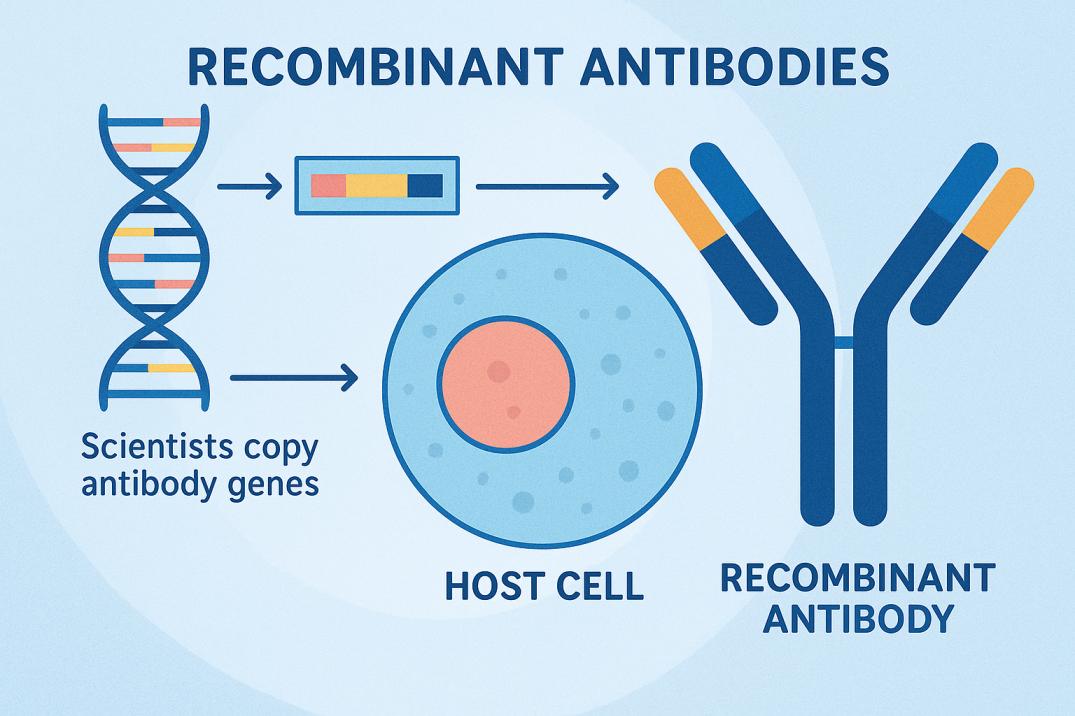
These antibodies are a lab-made version of monoclonal antibodies. Instead of using animals to produce them, scientists copy the genes for the antibody and insert them into special host cells (usually mammalian cells).
These cells then produce the antibody in a controlled lab environment. Other host types, like bacteria, yeast, or insect cells, can also be used.
Why Should One Use Recombinant Antibodies?
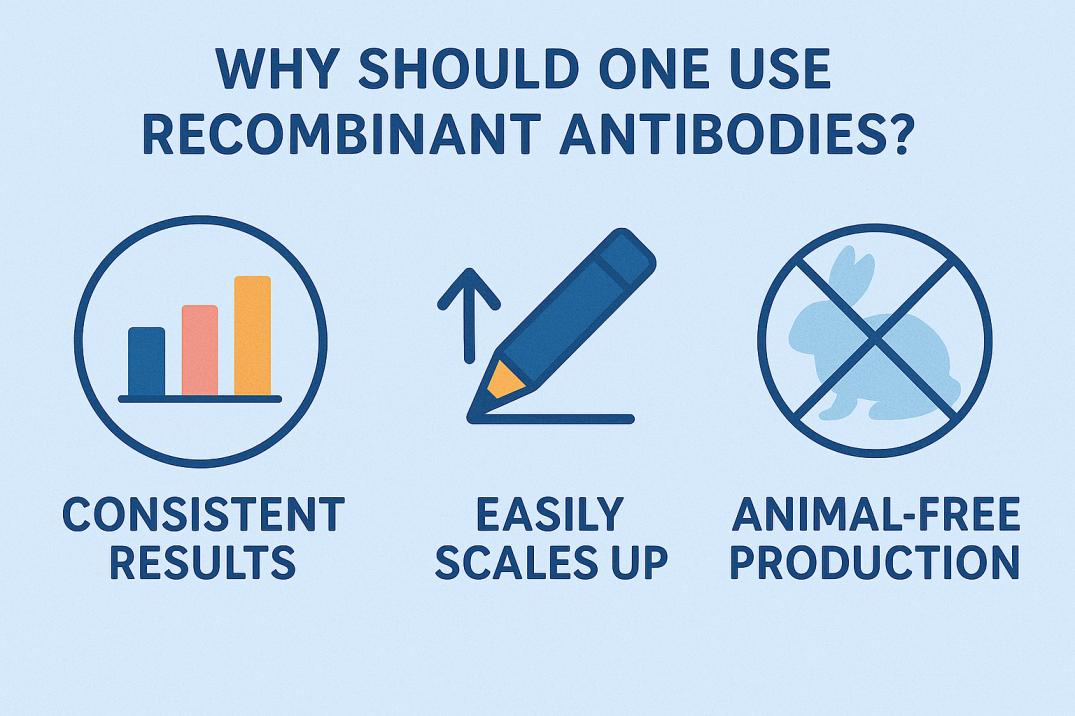
Consistent Results
Since the exact genetic code for the antibody is known and used every time, recombinant antibodies are very consistent from batch to batch.
Traditional methods, such as hybridomas, can lose stability with time. It causes changes in the antibody’s behavior.
Easily Scales Up
Recombinant antibodies are made using lab-based methods that can be easily scaled up for larger studies. Since the sequence is saved digitally, the same antibody can be reproduced as needed, even years later.
Easy to Modify
Knowing the full sequence of the antibody makes it easier for scientists to customize it.
For example:
- Switching the antibody type (isotype-switching)
- Changing the species it comes from (species-switching)
These changes are helpful in experiments that require multiple antibodies to work together without cross-reactions.
Animal-Free Production
The traditional methods used to rely on animals, while recombinant antibody production is animal-free. The antibodies are purified from lab-grown cell cultures, making the process more ethical and easier to control.
Types of Recombinant Antibodies
Chimeric Antibodies
These are one of the earliest types of recombinant antibodies. They were developed to solve a problem in antibody therapy.
When mouse-derived antibodies were given to humans, the human immune system often saw them as foreign and reacted against them.
To reduce this immune response, scientists in 1984 created chimeric antibodies. Those were produced by combining mouse and human antibody sequences using genetic engineering.
These antibodies typically contain:
- 30–35% mouse antibody
- 65–70% human antibody
The blend allows the antibody to keep its original target-binding ability (from the mouse) while making it more acceptable to the human immune system.
Creating chimeric antibodies is often the first step in developing humanized antibodies for therapeutic use. Advanced tools like computer modeling and region grafting techniques help increase the chances of success in this process.
Antibody Fragments
A full-sized antibody (like IgG) is made up of two light chains and two heavy chains, connected by special chemical bonds. Scientists have developed smaller versions of antibodies, called antibody fragments,
such as:
- scFv (single-chain variable fragment)
- Fab
- VHH (also known as nanobodies)
Because they are smaller in size, these fragments can:
- Enter tissues or tumors more easily than full-length antibodies
- Be used in imaging studies thanks to their shorter half-life, which means they stay in the body for a shorter time
These qualities make them promising tools for research in immunotherapy, especially for solid tumors.
How Are Antibody Fragments Made?
Originally, antibody fragments were created by using enzymes to cut full-size IgG antibodies:
- Pepsin cuts the antibody to make an F(ab')₂ fragment
- Papain can then further split it into two individual Fab fragments
However, this enzymatic method is limited and not ideal for large-scale production.
Thanks to advances in antibody engineering, scientists can now produce these fragments recombinantly:
- After cloning and sequencing the antibody genes, the fragments can be made in lab systems like HEK293 cells
- This method allows for more precise, scalable, and reliable production
High-Throughput VHH Production
With growing expertise in recombinant technology, platforms now exist that allow high-throughput production of antibody fragments like VHHs.
For example, specialized expression systems can achieve over 90% success rates in producing these fragments for research.
What Are Its Applications?
Recombinant antibodies (rAbs) offer unique advantages that make them suitable for specific research needs.
They are especially useful when you need:
- When a short time in the bloodstream is needed (the antibody doesn’t stay in the body for long).
- When a smaller antibody is needed to spread more easily through tissues or to get inside tumors.
- When the antibody needs to be made in yeast or bacteria (E. coli) to lower costs or to make large amounts more easily.
- When the antibody is designed without the Fc part, so it doesn’t trigger immune cells or cause receptors to stick together.
- When a bispecific antibody fragment is needed—meaning it can attach to two different targets at once, like BiTEs (bispecific T cell engagers), diabodies, or DARTs.
- When the antibody needs to be made in yeast or bacteria (E. coli) to lower costs or produce more, and also without the Fc part to avoid immune reactions and receptor clumping.
How Are Recombinant Antibodies Made?
Gene Cloning
Every antibody is made of two main parts:
- A heavy chain (VH)
- A light chain (VL)
Scientists start by using a method called PCR (polymerase chain reaction) to copy the genes for these chains.
To do this, they design special pieces of DNA called primers to help copy just the right sections.
Once the VH and VL genes are copied and purified, they are connected to a plasmid. It is a small circular DNA molecule used as a carrier. This plasmid will help the genes enter and work inside host cells.
If you're creating a special type of antibody fragment called scFv, a linker must be added between VH and VL to keep them connected as one single unit.
Transformation into Host Cells
Next, the engineered DNA (with VH and VL genes) is inserted into host cells, usually bacteria or other lab-friendly organisms.
It is done using a method called electroporation, which uses an electrical pulse to open the cell membrane and allow the DNA to enter.
Using highly competent cells (cells that take up DNA efficiently) is important to get good results.
Display and Selection
After the host cells start producing antibody fragments, scientists can screen and choose the best ones.
These techniques find antibody fragments that bind strongly to the target.
Some popular display methods include:
- Phage display: Uses viruses (phages) to show antibody fragments. It helps create large libraries of different antibodies.
- Ribosome display: Creates massive antibody libraries without needing cells at all. It is useful for finding rare or mutated versions.
- Yeast display: It uses yeast cells, which are closer to human cells in how they process proteins. It becomes ideal for expressing human-like antibodies.
To Wrap Up
Recombinant antibodies are becoming popular with many scientists because they are very consistent, sensitive, and easy to test. They can be used in many ways, making them great for research, disease testing, and medical treatments.
These antibodies can also help make antibody-based medicines cheaper and work better.
Because they can be specially designed, they can reach deep into tissues or carry medicines directly to specific cells. It gives researchers many new possibilities to explore and use them in different ways.
Faq's
How are recombinant antibodies made?
Recombinant antibodies are made by putting the genes for the antibody’s heavy and light chains into one or two small DNA circles called plasmids. These plasmids are then inserted into cells to produce the antibodies.
How does genetic recombination help make antibodies?
Scientists use genetic engineering to combine and change parts of antibody genes. This allows them to create special antibodies with new features in the lab.
Where does antibody recombination happen in the body?
In mammals, antibody genes are rearranged in immune organs—like the bone marrow (for B cells) and thymus (for T cells). This rearrangement, called V(D)J recombination, helps create diverse antibodies to fight many different threats.
What are recombinant proteins?
Recombinant proteins are proteins made in the lab using genetic engineering. They are important in medicine and research, often used as treatments for diseases.
What is the difference between native and recombinant antibodies?
Native antibodies come directly from natural sources and show the real form of the target but can be hard to get in large amounts.
Recombinant antibodies are made in the lab, so they are more consistent and easy to produce in large quantities, which is good for many tests.
Lead Clinical Research Coordinator (LCRC)
Cynthia Lee is the President of AAA Biotech and specializes in understanding highly validated and characterized monoclonal/polyclonal antibodies, recombinant proteins, and ELISA kits.
Related Posts