Antibody Storage: How to Preserve Monoclonal Antibodies
 Cynthia
6 min read
Cynthia
6 min read
In this Article


All of the products listed in AAA Biotech’s catalog are strictly for research-use only (RUO).
Key Takeaways
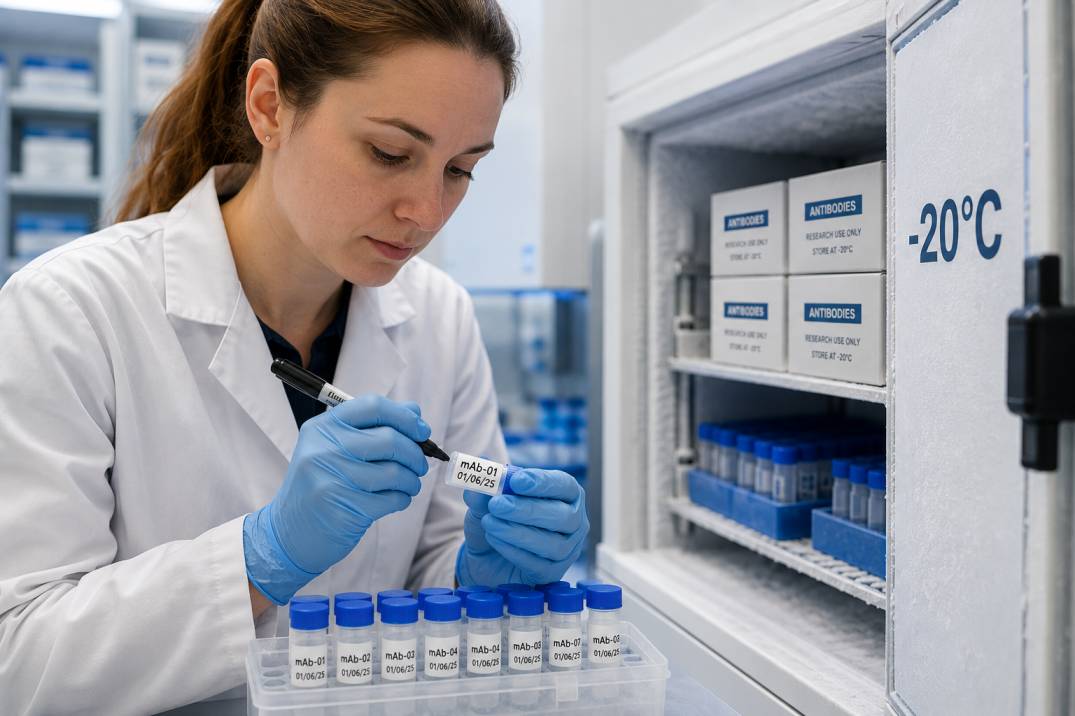
- Antibody storage temperature is the single most critical variable: 4 degrees Celsius for short-term use and minus 20 degrees Celsius for long-term preservation.
- Every freeze-thaw cycle degrades antibody storage quality. Aliquoting before freezing is the most practical way to prevent this.
- A well-formulated antibody storage buffer containing glycerol, BSA, and a preservative such as sodium azide protects activity during long-term freezing.
- Antibody shelf life depends more on actual storage conditions than on the printed expiry date.
- Fluorescent conjugates and cell signaling technology antibodies require especially careful handling due to their sensitivity to light and repeated temperature fluctuations.
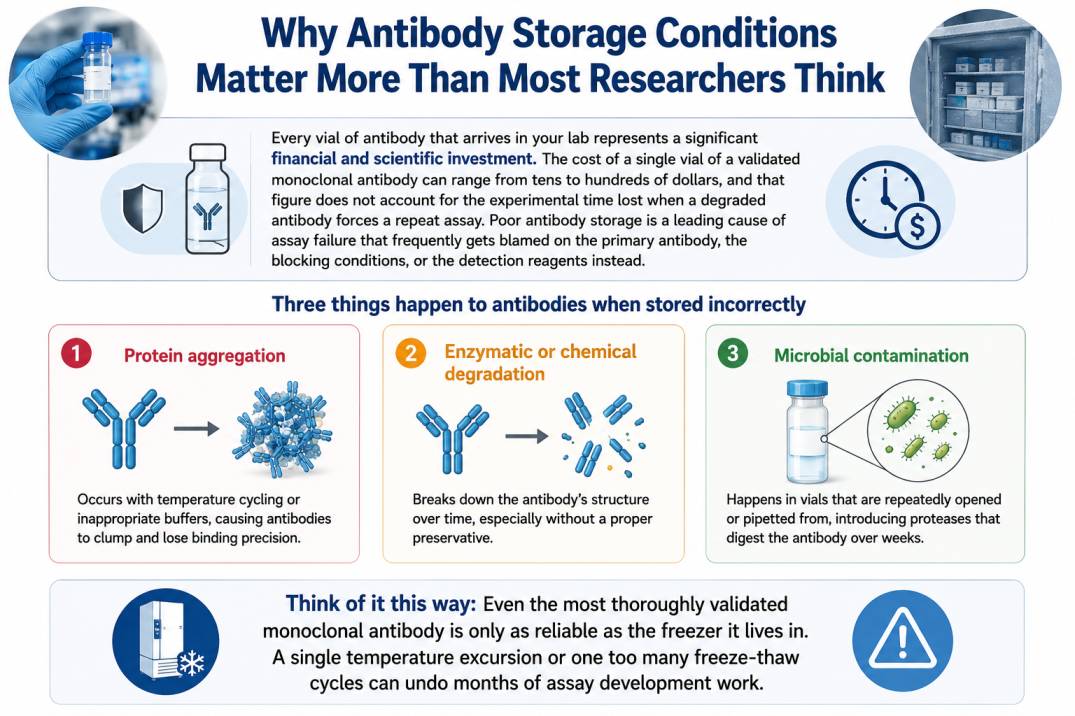
A monoclonal antibody that has been rigorously validated, lot-tested, and shipped to your lab in perfect condition can still fail to produce a clean result if it is stored incorrectly.
Aggregation, loss of binding activity, contamination, and degradation from repeated freeze-thaw cycles are all storage-related problems that get misattributed to the wrong causes, leading to wasted reagents, repeated experiments, and unreliable data.
This guide covers the correct antibody storage temperature for different situations, what a good antibody storage buffer contains, and the most common mistakes researchers make, along with exactly how to fix them.
The 5 Core Principles of Correct Antibody Storage
Antibodies are incredibly precise, highly effective, and surprisingly easy to ruin if you put them in the wrong environment. That’s exactly why mastering the five core principles of correct antibody storage matters.
1. Antibody Storage Temperature
The correct antibody storage temperature depends on how quickly you plan to use the antibody and how sensitive the specific formulation is to freezing.
- As a general principle, antibodies intended for use within two to four weeks can be kept at 4 degrees Celsius in a standard laboratory refrigerator.
- Antibodies that will not be used for a month or more should be moved to minus 20 degrees Celsius for long-term preservation.
- Ultra-low temperature storage at minus 80 degrees Celsius is appropriate for highly sensitive conjugates, precious research stocks, or any antibody where the manufacturer's datasheet specifically recommends it.
It is worth noting that some antibodies are shipped at ambient temperature, particularly those formulated in stabilizing buffers with high glycerol content. Arriving at room temperature does not mean they should be stored at room temperature.
Always transfer to the appropriate antibody storage temperature within 24 hours of receipt, following the specific instructions on the product datasheet.
2. Antibody Storage Buffer
The antibody storage buffer is the liquid environment that surrounds and protects the antibody during storage. A well-formulated antibody storage solution typically contains several key components that each play a distinct role in preserving antibody activity.
- PBS (Phosphate-Buffered Saline): Provides a physiologically appropriate pH that keeps the antibody structurally stable. Most antibodies are stored in PBS at pH 7.2 to 7.4.
- BSA (Bovine Serum Albumin): Acts as a carrier protein that stabilizes the antibody and prevents it from adsorbing to the walls of the storage vial, which can effectively reduce the working concentration without you realizing it.
- Glycerol: Prevents ice crystal formation during freezing. A concentration of 50 percent glycerol in the antibody storage buffer is standard for long-term frozen storage and is the primary reason many antibodies stored at minus 20 degrees Celsius do not fully solidify.
- Sodium Azide: A common antimicrobial preservative that prevents bacterial and fungal growth in the vial during refrigerated storage. Sodium azide is toxic and requires careful handling and institutional waste disposal procedures. It should not be used in cell culture applications or in any assay involving living cells.
⚠️ Safety Note: Sodium azide is a hazardous chemical. Always consult your institution's biosafety officer for correct handling, storage, and disposal requirements. Do not pour sodium azide-containing solutions down the drain or into metal pipes without checking local regulations.
3. Aliquoting
Every time a frozen antibody vial is thawed, used, and re-frozen, the antibody undergoes physical stress that degrades its performance incrementally.
Most monoclonal antibodies can tolerate three to five freeze-thaw cycles before a measurable loss in binding activity occurs, and some sensitive preparations are affected even sooner.
The solution is straightforward: aliquot the antibody into single-use volumes immediately upon receipt, before the first freeze.
4. Light, Air, and Contamination
Fluorescently conjugated secondary antibodies and fluorophore-labeled monoclonals are highly sensitive to light exposure.
Even brief exposure to ambient laboratory lighting degrades fluorescent dyes and reduces signal intensity in downstream assays. These antibodies should always be stored in amber or foil-wrapped tubes and handled in subdued light conditions during use.
Contamination is a more subtle risk. Never pipette directly from a shared stock vial. Always remove the volume you need using a clean, sterile pipette tip into a separate working tube.
5. Antibody Shelf Life
The printed expiry date on an antibody vial represents the manufacturer's guarantee of performance under their specified antibody storage conditions. It does not account for what happens in your lab after delivery.
The most reliable way to assess antibody shelf life in your own lab is to run a positive control from a freshly opened vial alongside each experiment and compare the signal intensity to your historical baseline.
If signal drops without a corresponding change in your protocol, degraded antibody storage conditions are the most likely explanation.
Antibody Storage Temperature: Quick Reference
| Storage Condition | Temperature | Typical Use Case | Key Risk |
|---|---|---|---|
| Short-term Bench Use | 4°C | Active experiments, within 2–4 weeks | Microbial growth without preservative |
| Standard Refrigerator | 4°C | Working aliquots, frequent use | Gradual activity loss beyond 1 month |
| Standard Freezer | −20°C | Long-term storage, 6–24 months | Ice crystals without glycerol in buffer |
| Ultra-low Freezer | −80°C | Precious stocks, sensitive conjugates | Thermal shock on thawing if rushed |
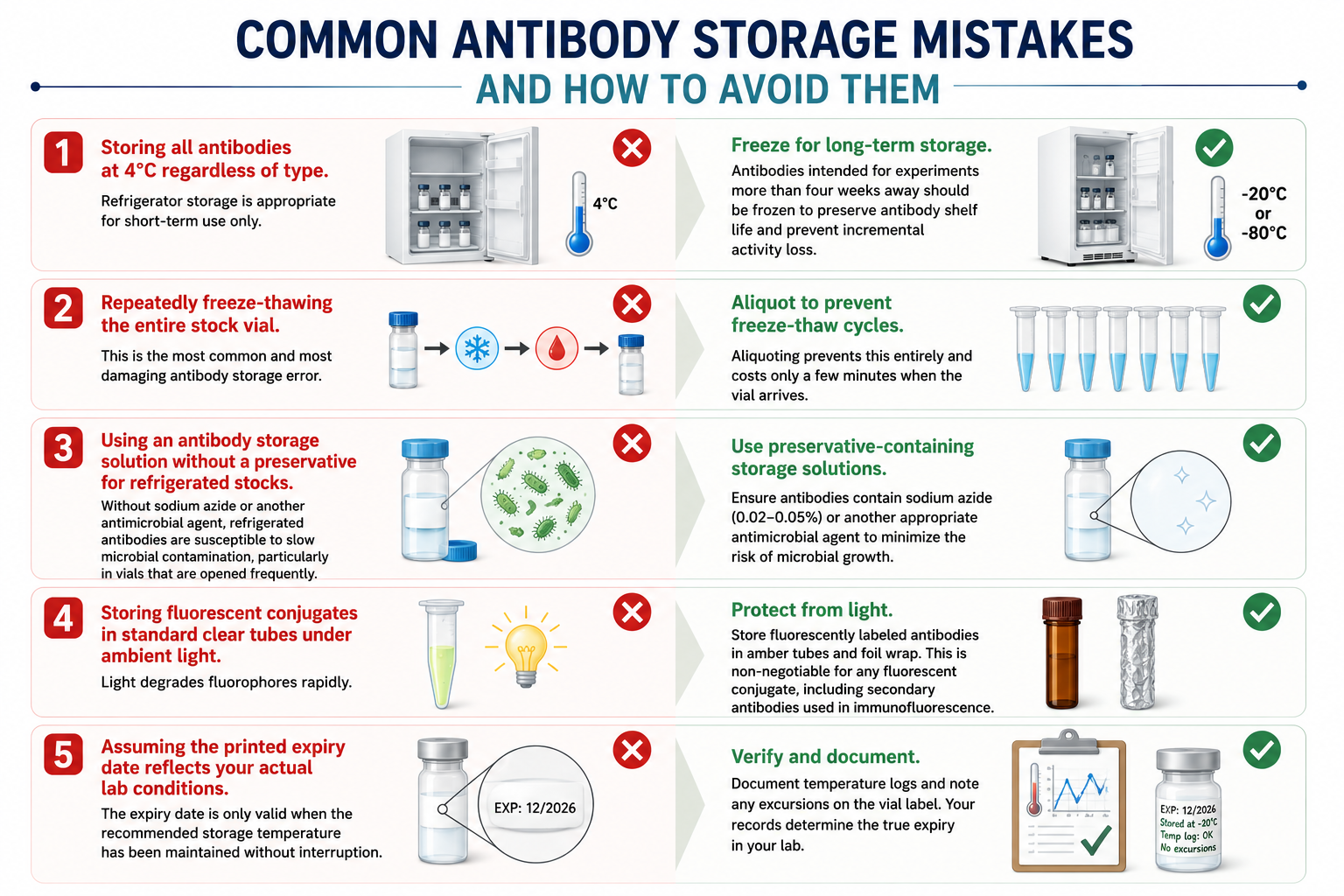
Common Antibody Storage Mistakes and How to Avoid Them
AAA Biotech Antibodies: Formulated and Validated for Long-Term Stability
At AAA Biotech, every monoclonal antibody in our catalog is formulated in a quality-controlled antibody storage buffer designed to maintain activity from the moment it leaves our facility to the moment it reaches your experiment.
Our products are tested for titer, specificity, and stability before shipping, and each vial is accompanied by a datasheet that includes clear antibody storage temperature instructions and antibody shelf life guidance specific to that formulation.
Browse the AAA Biotech catalog or contact us directly to confirm current pricing, availability, and lot-specific storage recommendations.
Faq's
How many freeze-thaw cycles can a monoclonal antibody tolerate?
Most well-formulated monoclonal antibodies can withstand three to five freeze-thaw cycles before a measurable decline in binding activity occurs. However, this varies by antibody, conjugate type, and antibody storage buffer composition. The most reliable way to minimize freeze-thaw damage is to aliquot the antibody into single-use volumes before the first freeze, so that each vial is only thawed once.
How do I know if my antibody has degraded in storage?
The most reliable indicator of antibody storage degradation is a drop in signal intensity in a positive control experiment compared to your historical baseline, with no corresponding change in protocol. Visual signs such as visible aggregation (cloudiness or particulates in the vial) or a color change in the solution are also indicators that the antibody has been compromised.
Should I add sodium azide to my antibody storage solution?
Sodium azide is an effective preservative for refrigerated antibody storage solutions and is already present in many commercial formulations. It is appropriate for use in biochemical assays such as ELISA and Western blotting. It must not be used in any application involving living cells because it inhibits mitochondrial function.
Can I store antibodies in a regular minus 20 degrees Celsius lab freezer?
A standard laboratory freezer set to minus 20 degrees Celsius is appropriate for most monoclonal antibody storage needs, provided the antibody storage buffer contains glycerol to prevent ice crystal formation.
How long do monoclonal antibodies last once the vial is opened?
Antibody shelf life after opening depends primarily on antibody storage temperature, buffer composition, and how many times the vial has been accessed. A refrigerated working aliquot in a well-formulated antibody storage solution with a preservative can remain stable for one to three months with careful handling.
Lead Clinical Research Coordinator (LCRC)
Cynthia Lee is the President of AAA Biotech and specializes in understanding highly validated and characterized monoclonal/polyclonal antibodies, recombinant proteins, and ELISA kits.
Related Posts